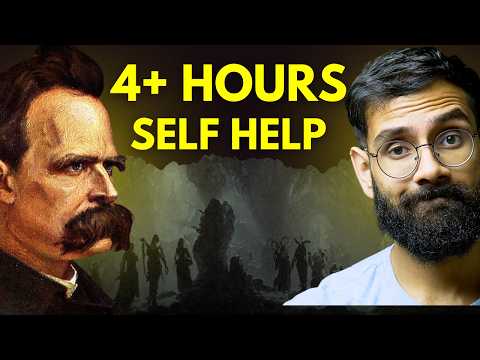
Friedrich Nietzsche challenges traditional moral values, arguing that our current moral system is rooted in resentment and promotes mediocrity. He contrasts 'master morality' with 'slave morality,' suggesting that the latter stifles human potential and leads to misery. Nietzsche advocates for a reevaluation of our values, emphasizing the importance of strength, power, and the will to dominate as essential to human flourishing.
Friedrich Nietzsche, the German philosopher known for his provocative ideas, challenges the very foundations of our moral beliefs. He poses a radical question: what if everything we know about right and wrong, good and evil, is fundamentally flawed? This blog post delves into Nietzsche's critique of morality, particularly his views on Christian values, the consequences of mediocrity, and the implications of his philosophy for our understanding of ethics.
Nietzsche's exploration of morality begins with a historical perspective. He suggests that our moral system has been shaped by resentment, much like the character Salieri from Peter Shaffer's play Amadeus. Salieri, consumed by envy of Mozart's talent, ultimately seeks to ruin him. Nietzsche uses this narrative to illustrate how resentment can lead to destructive behavior, not just for the target but also for the one harboring the resentment.
In Nietzsche's view, early human societies were dominated by powerful individuals who defined morality based on their own qualities—strength, competence, and the ability to dominate nature. This form of morality, which he calls "noble morality" or "master morality," is life-affirming and constructive. It encourages individuals to strive for personal excellence and fosters successful societies.
However, as societies evolved, a counter-morality emerged from the oppressed, which Nietzsche terms "slave morality." This morality arises from resentment against the powerful and values weakness, submission, and obedience. The slave morality demonizes the traits admired by the powerful, leading to a societal shift where the highest good is defined by the powerless rather than the strong.
Nietzsche warns that embracing slave morality can lead to mediocrity and passivity. He references Dostoevsky's Notes from Underground, where the protagonist's life is marked by inaction and self-doubt. Nietzsche argues that a fear of power and strength stifles human potential. To achieve greatness, one must possess strength and competence, as seen in historical figures like Napoleon, who exemplified the will to power.
According to Nietzsche, the fear of power suppresses extraordinary individuals, leading to a society that lacks vision and ambition. He challenges us to reconsider our relationship with power, suggesting that fearing it ultimately dooms both individuals and societies to insignificance.
Nietzsche critiques the foundation of our moral values, arguing that they stem from resentment rather than genuine aspiration. He illustrates this with Aesop's fable of the sour grapes, where the fox, unable to reach the grapes, convinces itself they are not worth having. This mindset, when applied to more significant desires like power and achievement, leads to self-hatred and frustration.
Living under slave morality, individuals are taught to view their natural desires as evil, resulting in a cycle of misery and mediocrity. Nietzsche posits that this denial of the will to power creates generations of self-loathing individuals who resent those who pursue their ambitions.
Nietzsche also critiques the "moral man," who imposes rigid moral standards on others while failing to recognize their own shortcomings. This moralistic attitude often stems from a desire to assert one's will to power under the guise of righteousness. Nietzsche argues that this moral indignation is an amoral force, merely a means of enforcing one's values on others.
He emphasizes that the desire to change the world is natural and should not be constrained by moral justifications. Exceptional individuals, like Napoleon, achieve greatness by transcending conventional morality, acting beyond good and evil.
Nietzsche's analysis of morality is controversial, challenging democratic and egalitarian ideals. He prompts us to reconsider our values, suggesting that strength and power can be positive forces for humanity. A morality that glorifies weakness and meekness may hinder personal growth and societal progress.
His insights encourage skepticism towards those who define their identity through moral superiority, as they may harbor hidden motives. Nietzsche's philosophy invites us to question our fundamental concepts of good and evil, urging us to engage critically with our values.
In conclusion, Nietzsche's radical critique of morality serves as a call to reevaluate our ethical frameworks. He advocates for a philosophy that embraces strength, power, and the will to dominate, fostering a life-affirming approach to existence. By challenging traditional moral assumptions, Nietzsche opens the door for a new understanding of what it means to live a fulfilling and meaningful life.