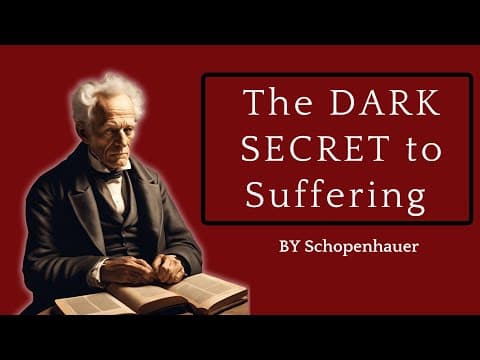
Arthur Schopenhauer's philosophy posits that suffering is not an aberration but a fundamental aspect of existence. His early life experiences shaped his belief that true understanding and wisdom come from confronting life's inherent suffering. Schopenhauer's ideas on the will to life, the nature of desire, and the transformative potential of art and compassion provide a profound framework for understanding the human condition.
What if suffering isn't something that went wrong in life but is woven into life's very fabric? Arthur Schopenhauer, often called the philosopher of life's darker truths, believed precisely this. He saw suffering not as an accidental misfortune but as the true essence of existence. Today, we dive deep into Schopenhauer's radical philosophy on suffering, examining the profound experiences that shaped his views and why he thought facing life's bleakest truths was the only path to genuine understanding and wisdom.
Schopenhauer's early life was marked by tragedy. Born into a wealthy merchant family in 1788, he was familiar with privilege, but that privilege was short-lived. His father, Hinrich, a man driven by ambition, died when Schopenhauer was only 17, with many believing it was suicide. This event profoundly impacted his young mind, instilling a suspicion that even those who achieve success can be crushed by life's weight.
This personal loss became a raw, unavoidable lesson for Schopenhauer, reinforcing his belief that true contentment remains out of reach, even when we achieve everything we think will make us happy. His tumultuous relationship with his mother, Johanna, further shaped his worldview. A socialite and celebrated novelist, Johanna found her son's dark outlook insufferable, famously telling him he was impossible to live with. Their estrangement left a deep scar on him, reinforcing his belief in the loneliness of human existence.
Choosing solitude over the company of those who couldn't understand him, Schopenhauer withdrew from society. Unlike other philosophers who might dabble in theories while living conventional lives, he lived his philosophy. He became solitary and fiercely independent, finding solace only in his books and the loyal companionship of his poodles, all named Atman after the concept of the soul in Hinduism. He believed animals embodied a kind of purity and simplicity, suffering from the blind forces of existence without the illusions and ambitions that often lead humans astray.
At the heart of Schopenhauer's philosophy lies the idea of the will to life, a concept that would shape all his thinking. He saw this will as an insatiable, mindless force driving every living being. Unlike many philosophers who viewed life as guided by reason or divine purpose, Schopenhauer perceived life's engine as something blind, relentless, and indifferent to our happiness. This will pushes us to desire, crave, and pursue one thing after another without ever being truly satisfied.
In Schopenhauer's view, our lives are driven not by meaning but by this endless striving. He famously wrote, "Man can indeed do what he wants, but he cannot will what he wants." Our actions may feel like ours, but our deepest desires are beyond our control, pulling us through life as though tethered to a relentless force.
One of Schopenhauer's most famous analogies is that life is like a pendulum swinging between pain and boredom. When we lack what we want, we suffer from longing, jealousy, or frustration. However, as soon as we attain it, satisfaction is brief, and we soon find ourselves in the dullness of boredom, ready for a new desire to consume us. He wrote, "Life is an endless pain with intermittent delights, which only serve to awaken us to new forms of desire." This powerful image resonates with anyone who has ever achieved a goal only to find themselves searching for the next one.
Despite his bleak outlook, Schopenhauer wasn't merely a messenger of despair. He saw within suffering the potential for transformation. His views were influenced by Eastern philosophies, particularly Buddhism, which he discovered through early translations available in Europe. Schopenhauer admired the Buddhist insight that suffering is rooted in desire and that letting go of attachments offers a path to inner peace.
However, unlike Buddhism, which often sees renunciation as part of a spiritual journey, Schopenhauer viewed it as a practical approach to life itself. He believed that moments of release from the will, such as through art, music, or meditation, provided rare glimpses of peace. For him, music was the universal language of mankind, giving voice to the essence of the will without being entangled in words or meaning. In those moments, we step outside our ceaseless wanting and experience a moment of pure being.
Schopenhauer placed high importance on art because he saw it as a means of breaking the spell of desire, even if only temporarily. In art, we can glimpse a world free from the demands of the will. He wrote, "Art is the right hand of nature; the latter has only given us being, and the former has made us men." In those rare moments of artistic engagement, we experience life as it truly is, beyond suffering and the ceaseless pull of desire.
Compassion also played a profound role in Schopenhauer's philosophy. Although often remembered as a pessimist, he believed that compassion offered a rare opportunity for moral transcendence. By recognizing the suffering of others, we glimpse something beyond ourselves. For Schopenhauer, compassion was more than an emotion; it was a doorway out of the prison of self. He argued that compassion is the basis of morality, a revolutionary idea in an era dominated by rationalist philosophies.
As Schopenhauer aged, his reclusiveness deepened. He spent his later years alone, his only companions being his beloved poodles, the philosophy books he had written, and the quiet certainty of his beliefs. He became a figure of intellectual solitude, whose thoughts defied the optimism of his time, laying bare the stark truths of existence. He once said, "To live alone is the fate of all great souls," perhaps meaning this more literally than most philosophers.
In his final years, Schopenhauer came to understand that suffering wasn't an error in the structure of life; it was the structure itself. This insight, he believed, wasn't bleak or hopeless but liberating. Schopenhauer left us with a challenging question: if suffering truly defines life, can we find meaning transcending our endless desires? Is there a truth hidden within suffering that can reveal the essence of who we are?
If we embrace this truth, what does it mean to live fully, knowing that life's darker depths are unavoidable? Perhaps Schopenhauer's greatest insight is his challenge to us—not to escape suffering but to let it shape us, to see in it a reflection of what it means to be truly alive.
In conclusion, Schopenhauer's philosophy invites us to confront suffering not as an aberration but as an integral part of the human experience, urging us to seek understanding and meaning within it.