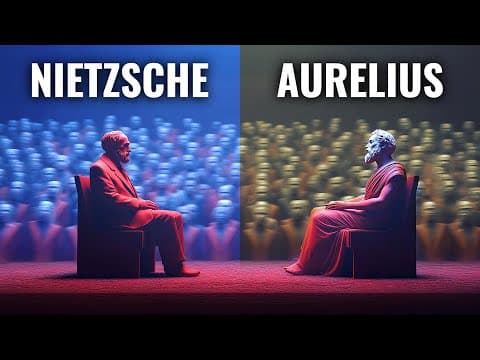
In a thought-provoking debate, Nietzsche and Marcus Aurelius discuss the nature of self-disgust, virtue, and the role of personal values. Nietzsche challenges the Stoic acceptance of one's role in the cosmos, arguing for the creation of new values that embrace life and individuality. Aurelius defends the importance of reason and virtue, emphasizing the need for shared moral standards. Their dialogue raises critical questions about self-identity, societal values, and the struggle between personal
In a captivating dialogue, two philosophical giants, Friedrich Nietzsche and Marcus Aurelius, engage in a debate that delves into the complexities of self-perception, virtue, and the essence of existence. Their discussion begins with a profound question: What happens when we look in the mirror and feel disgust or disappointment with ourselves? This inquiry leads them to explore the roots of self-hatred and the philosophical implications of our reflections.
Nietzsche opens the debate by reflecting on the feelings of disgust and disappointment that often accompany self-examination. He suggests that these feelings arise from a misunderstanding of our true selves. The physical body, he argues, is merely a temporary vessel, while the soul, with its capacity for reason and justice, is what we must govern. He emphasizes that we often torment ourselves over superficial aspects, forgetting that we are merely actors in a cosmic play, tasked with playing our roles with virtue.
Aurelius counters Nietzsche's perspective by asserting that his philosophy of cosmic acceptance is not a sign of surrender but rather a demonstration of strength. He argues that true virtue requires the courage to act justly, even when faced with overwhelming passions. Aurelius acknowledges that many interpretations of virtue have become corrupted, particularly by later Christian teachings, but he maintains that the essence of virtue is rooted in reasoned choices that benefit humanity.
Nietzsche challenges Aurelius by questioning the origins of his moral standards. He argues that the values Aurelius espouses were shaped by the weak, who sought to impose their will through guilt and shame. Nietzsche posits that self-hatred may not be an error but a symptom of rebellion against inherited values that suppress our natural instincts and desires.
Aurelius defends his stance by emphasizing the importance of reason over passion. He believes that true freedom lies in choosing which constraints to accept, advocating for justice and the good of the whole over personal desires. Nietzsche, however, critiques this view, suggesting that Aurelius's reason serves the interests of those in power, perpetuating a cycle of control and submission.
The debate intensifies as Nietzsche argues that the moral standards upheld by Aurelius's philosophy often lead to a life-denying existence. He points to historical atrocities committed in the name of virtue, such as the Crusades and the Inquisition, as evidence that traditional moral frameworks can become oppressive. Aurelius acknowledges the potential for corruption in moral standards but insists that shared values are necessary for societal cohesion.
Nietzsche counters that the quest for new values should not be dismissed. He advocates for a philosophy that embraces life and vitality, rather than one that teaches individuals to suppress their instincts. He questions whether it is possible to create a new moral framework that is not tainted by the failures of the past.
As the conversation progresses, Aurelius expresses concern about the implications of Nietzsche's call for self-creation. He warns that individuals who attempt to reinvent themselves may end up in a cycle of self-criticism and disappointment. Nietzsche responds by asserting that true self-creation involves embracing one's imperfections and contradictions, rather than adhering to rigid standards of perfection.
Aurelius argues that discipline and self-examination are essential for personal growth. He believes that individuals should strive to overcome their natural impulses through reasoned choices. Nietzsche, however, critiques this approach, suggesting that it can lead to a form of self-torture, where individuals become trapped in a cycle of guilt and shame.
The two philosophers grapple with the implications of their respective philosophies on the individual. Aurelius emphasizes the importance of duty and responsibility, while Nietzsche advocates for a more liberated approach that encourages individuals to embrace their desires and passions.
As their debate draws to a close, both Nietzsche and Aurelius acknowledge the need for honest reflection on the origins of our beliefs and values. They recognize that many individuals struggle with self-hatred and dissatisfaction, often measuring themselves against standards imposed by society.
Nietzsche's challenge to question the validity of these standards resonates deeply, urging individuals to consider whether their self-hatred is justified. Aurelius, on the other hand, emphasizes the importance of practical exercises in self-discipline and the need for shared moral frameworks to guide behavior.
Ultimately, their dialogue serves as a powerful reminder of the complexities of human existence and the ongoing struggle to find meaning and authenticity in a world filled with competing values. The debate between Nietzsche and Aurelius invites us to reflect on our own beliefs, encouraging a deeper understanding of ourselves and the societal constructs that shape our perceptions of worth and virtue.