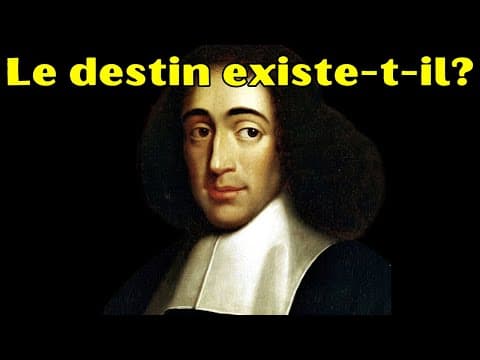
This blog post delves into Spinoza's philosophy, particularly his views on the relationship between chance and necessity, the nature of God, and the implications for human freedom and understanding of reality. It highlights how Spinoza challenges traditional notions of a personal God and destiny, advocating for a rational understanding of nature as devoid of intention, thus reshaping our perception of freedom and existence.
In this post, we will explore the profound ideas of the philosopher Baruch Spinoza, particularly his views on the relationship between chance and necessity, the nature of God, and the implications for human freedom and understanding of reality. Spinoza's philosophy challenges conventional beliefs about a personal God and destiny, advocating for a rational understanding of nature.
To grasp Spinoza's ideas, let’s begin with a simple thought experiment. Close your eyes and focus on your date of birth. You were born on a specific day, at a specific time, and in a specific place. However, upon reflection, you realize that you could have been born a few days earlier or later, or even in a different location. Your birth is the result of a series of coincidences and events that could have easily unfolded differently. This realization leads us to the notion that your existence is both a product of chance and a necessary outcome of a causal chain that defines reality.
Spinoza posits that chance and necessity are not opposing forces but rather two perspectives on the same reality. Every event in nature can be explained through a series of causes, yet the existence of these events is itself a mystery. This paradox is central to understanding Spinoza's philosophy, as he argues that all reality is necessarily contingent upon a series of causal relationships.
In the first part of his work, "Ethics," Spinoza introduces his concept of God, which diverges significantly from traditional religious interpretations. For Spinoza, God is not a transcendent being separate from nature; rather, God is synonymous with nature itself. He defines God as the totality of causes that exist in the physical world, devoid of intention or will. This perspective challenges the anthropomorphic view of God prevalent in many religions, where God is seen as a personal entity with human-like qualities.
To understand Spinoza's view of God, it is crucial to differentiate between power and potency. Power refers to the political and legal authority exercised by individuals or groups, while potency is the inherent capacity to produce effects without any intention. Spinoza's God embodies this potency, acting as an impersonal force of nature rather than a decision-making entity.
Spinoza argues that humans often project their own experiences onto nature, mistakenly believing that nature operates with intention and purpose. This anthropomorphism leads to the illusion of free will, where individuals perceive themselves as autonomous agents capable of making independent choices. However, Spinoza asserts that our actions are determined by a complex web of causes, and the belief in free will is merely an illusion born from ignorance of these underlying causes.
Spinoza highlights that all humans are born ignorant of the true causes of things. This ignorance fosters the belief in a providential God who guides events according to a divine plan. When individuals encounter events that seem serendipitous or fateful, they often attribute these occurrences to destiny, reinforcing the illusion of a predetermined path.
Spinoza critiques the notion of finalism, the belief that nature operates with specific ends or purposes. He argues that this perspective is rooted in a misunderstanding of causality. For instance, people often claim that certain features of nature exist for the benefit of humanity, such as eyes for seeing or legs for walking. However, Spinoza contends that these attributes are not designed with intention; rather, they are the result of natural processes.
According to Spinoza, the phenomena we observe in nature do not possess inherent meaning or purpose. Instead, they are the result of causal relationships that operate independently of human desires or intentions. This understanding liberates us from the constraints of superstitious beliefs and allows for a more rational approach to understanding the world.
Spinoza's philosophy redefines freedom not as the absence of constraints but as the understanding of the deterministic nature of reality. True freedom arises from recognizing the causes that influence our actions and desires. By comprehending these causal relationships, individuals can align their actions with their true interests, thereby achieving a form of liberation.
The belief in free will often leads individuals to feel trapped by their circumstances. Spinoza argues that this perception of freedom is misleading. For example, one might believe that owning a car grants them freedom of movement, yet the responsibilities and costs associated with car ownership can create new constraints. Understanding the true nature of these relationships allows individuals to make more informed choices that genuinely enhance their freedom.
In conclusion, Spinoza's philosophy offers a profound critique of traditional notions of God, destiny, and free will. By emphasizing the importance of understanding the causal relationships that govern our existence, Spinoza encourages us to move beyond superstitions and embrace a rational view of nature. This perspective not only reshapes our understanding of reality but also empowers us to navigate our lives with greater clarity and purpose. Ultimately, Spinoza teaches us that true freedom lies in recognizing the necessity of nature and aligning our desires with its inherent order.