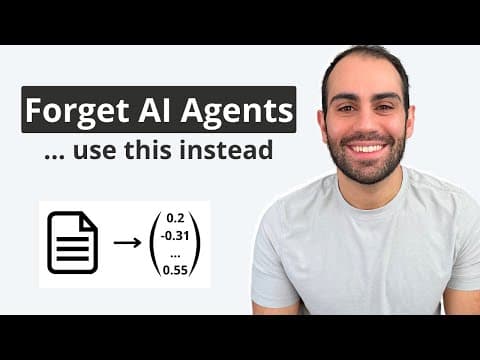
This blog post delves into the concept of text embeddings, explaining their significance in text analysis, and presents two practical use cases: text classification and semantic search, complete with Python code examples.
In recent times, there has been a surge of excitement surrounding large language models (LLMs) and AI agents. However, a significant innovation that deserves attention is the advancement in text embeddings. This post will explore text embeddings in detail and present two high-value use cases: text classification and semantic search.
Text embeddings are a method of translating words into numerical representations. This transformation is crucial because text, unlike numbers, is not inherently computable. For instance, if you were to summarize the heights of individuals at a networking event, you could easily compute an average using numerical data. However, summarizing job descriptions from the same event poses a challenge, as there is no straightforward mathematical operation to summarize text.
Text embeddings solve this problem by converting text into meaningful numerical representations. For example, job descriptions can be mapped to a set of numbers that capture their inherent meanings. In a visual representation, similar job descriptions will be located close together in the embedding space, while dissimilar ones will be farther apart.
While tools like ChatGPT can summarize text effectively, they may not be suitable for all applications, especially those requiring integration into products or broader software systems. Here are some reasons to consider using text embeddings:
Text classification involves assigning labels to pieces of text. For example, you might classify job descriptions from a networking event to determine which ones belong to data analysts. This process can be visualized as a classification task where job descriptions are plotted in an embedding space, and a line separates data analysts from non-data analysts.
To demonstrate text classification using text embeddings, we will classify resumes as either data scientists or not. The following steps outline the process:
Here is a simplified version of the code:
import openai
import pandas as pd
import numpy as np
from sklearn.ensemble import RandomForestClassifier
from sklearn.metrics import roc_auc_score


resumes = pd.read_csv('resumes.csv')


embeddings = generate_embeddings(resumes['text'])


X = embeddings
y = resumes['is_data_scientist']
classifier = RandomForestClassifier()
classifier.fit(X, y)


predictions = classifier.predict(X_test)
roc_auc = roc_auc_score(y_test, predictions)
print(f'ROC AUC: {roc_auc}')
In this example, overfitting may occur due to the high number of predictors relative to the number of records. To mitigate this, it is advisable to use a larger dataset and ensure that the training data reflects real-world scenarios.
Semantic search enhances traditional keyword search by returning results based on the meaning of a user's query rather than exact word matches. For instance, if a user queries, "I need someone to build my data infrastructure," semantic search can identify relevant job descriptions that may not contain the exact phrase but are contextually related.
To implement semantic search, we will follow these steps:
Here is a simplified version of the code:
import pandas as pd
import numpy as np
from sentence_transformers import SentenceTransformer


resumes = pd.read_csv('resumes.csv')


model = SentenceTransformer('all-MiniLM-L6-v2')
resume_embeddings = model.encode(resumes['text'].tolist())


query = "I need someone to build my data infrastructure"
query_embedding = model.encode([query])


distances = np.linalg.norm(resume_embeddings - query_embedding, axis=1)


top_indices = np.argsort(distances)[:10]
print(resumes.iloc[top_indices])
To improve search results, consider employing a hybrid approach that combines keyword-based search with semantic search. This can be achieved by first filtering results using keywords and then applying semantic search to refine the results further. Additionally, fine-tuning embedding models for specific domains can enhance performance in specialized fields.
Text embeddings offer powerful tools for text analysis, enabling effective classification and semantic search. By understanding and implementing these techniques, you can enhance your data-driven applications and improve user experiences. If you want to dive deeper into this topic, consider exploring additional resources and tutorials on text embeddings and their applications in data science.