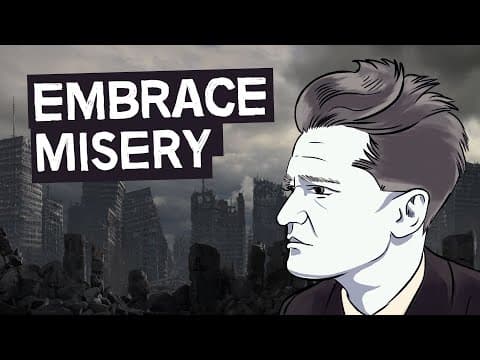
Emil Cioran, a Romanian philosopher, challenges societal norms by embracing suffering and despair as integral parts of the human experience. His works, particularly 'On the Heights of Despair', argue that the pursuit of happiness is futile and that confronting life's darker aspects leads to a deeper understanding of existence. Cioran's philosophy promotes the idea that true appreciation of life comes from engaging with its inherent pain and absurdity, rather than avoiding it through superficial means.
Emil Cioran, a Romanian philosopher, observed that modern society often shies away from confronting the darker sides of existence. We tend to hide illness behind the walls of hospitals and avoid discussions about death, viewing it as something horrific. In stark contrast, Cioran's writings embrace these uncomfortable realities, focusing on themes of misery, pain, and suffering. He famously referred to his prolific writing as "suicide postponed," suggesting that his engagement with despair became a form of salvation.
Delving into Cioran's work, particularly his first book, On the Heights of Despair, can be a daunting task. The aphoristic and poetic style, combined with a lack of cohesiveness, can make comprehension challenging. Despite multiple readings, many find themselves grappling with the depth of his ideas. However, this struggle may be precisely what makes exploring Cioran's philosophy worthwhile. His insights into the futility of pursuing happiness and the profundity of despair offer a unique perspective on the human condition.
Cioran could be labeled an anti-philosopher, though he might reject such a classification. He believed that the essence of existence should not be categorized but experienced in its raw form. Writing On the Heights of Despair in his early twenties, Cioran later acknowledged that this act saved his life. His writings reflect a cathartic process, allowing him to confront life's suffering rather than evade it. He stated, "Creativity is a temporary salvation from the claws of death."
For Cioran, despair is not something to flee from; rather, it is an intrinsic part of life. He posited that experiencing suffering does not equate to living incorrectly. Instead, he viewed despair as a profound aspect of the human experience, suggesting that happiness is often superficial and fleeting. Cioran's writings reveal a deep appreciation for life, stemming from his willingness to engage with its darkest aspects.
Cioran critiques the societal obsession with happiness, arguing that this pursuit is ultimately pointless. He believed that humanity constructs elaborate systems—such as religion and philosophy—to avoid confronting life's inherent pain. These structures often attribute meaning to suffering, providing comfort through the notion that "everything happens for a reason." However, Cioran contended that such rationalizations dilute the raw experience of existence.
One of the primary sources of human suffering, according to Cioran, is the absurdity of life. He asserted that life is inherently meaningless, and any attempt to find meaning is futile. This perspective aligns with the ideas of existentialists like Albert Camus, who also recognized the absurdity of human existence. Cioran argued that this realization should not lead to despair but rather serve as a reason to live fully.
Cioran's worldview positions him as a nihilist, yet one who advocates for experiencing life in its entirety. While nihilism often evokes feelings of hopelessness, Cioran encourages embracing the pain of existence. He believed that suffering reveals profound truths about the human condition, and engaging with it can lead to greater self-understanding and empathy for others.
Cioran's fascination with despair is evident throughout his work. He suggests that if we truly confront our suffering, we can gain clarity about life. Reflecting on personal experiences of loneliness and despair, one might find beauty in these moments, recognizing their role in shaping identity. Cioran's philosophy invites readers to reconsider their relationship with suffering and happiness, suggesting that both are integral to the human experience.
Emil Cioran's philosophy challenges us to confront the darker aspects of life rather than avoid them. By embracing suffering and recognizing the absurdity of existence, we can cultivate a deeper appreciation for life. Cioran's writings serve as a reminder that true understanding comes from engaging with our pain, ultimately leading to a richer, more authentic experience of being alive.