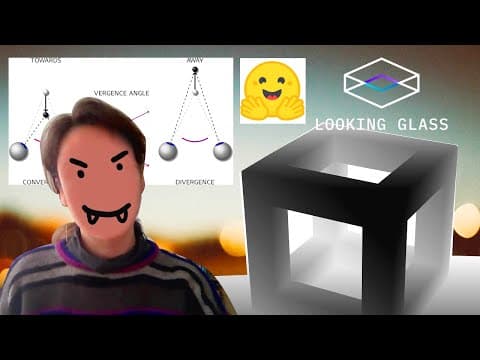
This blog post delves into the concept of depth maps, explaining their significance in visual perception and showcasing various depth map generators, including their strengths and weaknesses, to help artists and creators choose the best tool for their needs.
Depth perception is a fascinating aspect of visual experience, allowing us to interpret the three-dimensionality of objects from two-dimensional images. This perception relies on various visual cues, known as binocular and monocular cues. Binocular cues involve the differences between our two eyes' viewpoints, while monocular cues can be perceived with just one eye.
A depth map is an image that conveys the distance of surfaces from a specific viewpoint. Typically, lighter areas on a depth map indicate proximity, while darker areas suggest distance. Some depth maps may also encode luminance relative to the focal point rather than the camera's viewpoint.
In this exploration, we will review several depth map generators available on platforms like Hugging Face and Looking Glass, assessing their performance and suitability for different artistic needs.
This user-friendly interface allows users to drag and drop images to generate depth maps. However, the initial results often lack dynamic range, making it challenging to discern depth accurately.
Midas is another machine learning model found on Hugging Face. It produces better results than the previous generator, but the depth representation can still be somewhat flat, particularly for subjects in the foreground.
DPT shows significant improvement in depth mapping, with clearer gradients and outlines. The depth map generated by DPT effectively highlights features like the chin and forearm, making it a strong contender for detailed depth representation.
This tool offers a more dynamic range in depth mapping. The chin and other features are well-defined, providing a more nuanced representation compared to Midas. It stands out as one of the best options for generating depth maps.
The Looking Glass converter excels in creating detailed depth maps, showcasing a high level of nuance and clarity. The gradients and outlines are well-defined, making it an excellent choice for artists seeking precision in their depth maps.
Using a monocular approach, De Tomo generates depth maps with a variety of colors. While it offers interesting visual outputs, the Looking Glass Studio can read these maps, albeit with some limitations in clarity.
An intriguing approach involves using a stable diffusion model to generate depth maps based on style inputs. This method allows artists to create depth maps from existing images, offering a unique perspective on depth representation. By manipulating these depth maps in software like Photoki, artists can explore creative possibilities, blending color and depth in innovative ways.
In conclusion, the exploration of depth map generators reveals a range of tools available for artists and creators. Each generator has its strengths and weaknesses, making it essential to experiment with different options to find the best fit for specific artistic needs. Whether you prioritize detail, dynamic range, or creative flexibility, there is a depth map generator that can enhance your visual projects.
As technology continues to evolve, the potential for depth mapping in creative applications will only expand, offering exciting opportunities for innovation in visual storytelling.