This blog post delves into the cultural region of Northwest Vietnam, highlighting its diverse ethnic groups, unique traditions, and the significance of the Thai people in shaping the area's cultural identity.
In this post, we will explore the cultural region of Northwest Vietnam, drawing from the works of Trần Quốc Vượng and Ngô Đức Thịnh. Vietnam's cultural landscape is divided into seven distinct regions, and we will focus on the Northwest region, which is rich in diversity and tradition.
Cultural regions can be defined in various ways. The concept of cultural diffusion, popular in Western thought during the late 19th century, suggests that culture originates from a central point and spreads outward. In contrast, the cultural region theory, which gained traction in the United States in the late 20th century, emphasizes the coexistence of multiple ethnic groups within the same territory, each contributing to a shared cultural identity.
Additionally, the economic-cultural region theory from the former Soviet Union posits that cultural regions may overlap with geographical regions but are not entirely synonymous. A cultural region is characterized by the historical interactions among its inhabitants, leading to shared cultural traits in both material and spiritual aspects.
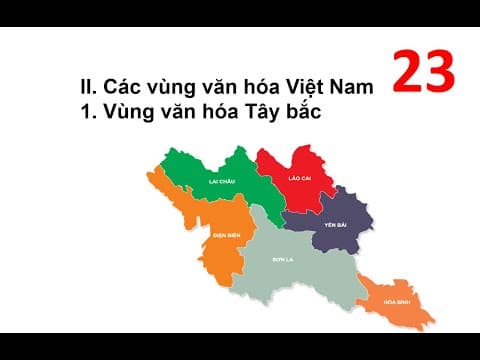
The Northwest cultural region includes the provinces of Lai Châu, Lào Cai, Điện Biên, Sơn La, Yên Bái, and Hòa Bình. This area is known for its rugged mountainous terrain and is bordered by significant rivers such as the Hồng, Đà, and Mã.
The Northwest is home to over 20 ethnic groups, each with distinct cultural practices. The population can be categorized into three ecological types:
Among these groups, the Thai people are the most populous and play a crucial role in the cultural identity of the Northwest.
The economy in the Northwest is primarily based on shifting cultivation, characterized by terraced rice fields. The Thai people have developed an intricate irrigation system known as "mương phai," which channels water from streams to their terraced fields. This agricultural practice is vital for sustaining their livelihoods.
The Thai cuisine is notable for its variety of rice dishes, particularly sticky rice, which is a staple in their daily meals and during festivals. The region's abundant rivers provide a source of fish, leading to popular dishes like grilled fish. Additionally, the Thai people have a rich tradition of foraging for wild vegetables and bamboo shoots, which are commonly featured in their meals.
The traditional attire of the Thai people includes the "sườn xám" and the "khăn piêu," a scarf that symbolizes beauty and skill in embroidery. The creation of the "khăn piêu" is a significant cultural practice, often gifted as a token of affection.
Thai architecture is represented by two main house types: the "nhà khứ tháng" (a traditional stilt house) and the "nhà đai khiên" (a house with a curved roof). The design of these homes reflects the cultural values and social structures of the Thai community.
The Thai people practice polytheism and believe in a spiritual world where ancestors play a significant role. Notable festivals include the "Sên Bản Sên Mườn" and the "Hoa Ban" festival, which celebrate their cultural heritage and agricultural practices.
The H'Mong and Dao communities, residing in the highlands, have distinct cultural practices. The H'Mong are known for their maize-based diet, with dishes like "mèn mén" (steamed corn flour) being staples. Their vibrant clothing, often made from intricately woven fabrics, reflects their artistic heritage.
The Dao people celebrate significant life events with elaborate rituals, such as the "cấp sắc" ceremony, marking the transition to adulthood for boys. This ceremony involves extensive preparations and community participation.
The Northwest cultural region of Vietnam is a tapestry of ethnic diversity, rich traditions, and unique lifestyles. The Thai people, as the predominant group, significantly influence the cultural identity of this area. Understanding these cultural nuances not only enriches our appreciation of Vietnam's heritage but also highlights the importance of preserving these traditions for future generations.