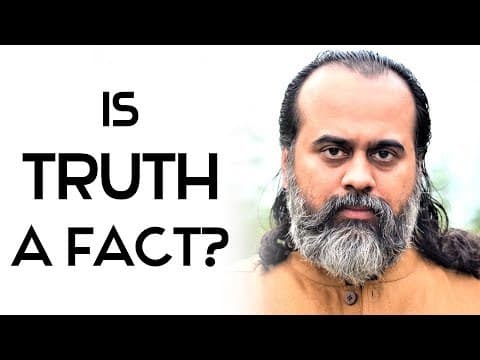
This blog post delves into the philosophical discussion presented by Acharya Prashant on the relationship between truth and facts, emphasizing that while facts are accessible and knowable, truth transcends human understanding and existence.
In a thought-provoking discussion, Acharya Prashant addresses the complex relationship between truth and facts, challenging common perceptions and encouraging a deeper understanding of these concepts. This exploration reveals that while facts can be known and articulated, truth exists beyond the realm of human comprehension.
Acharya Prashant begins by asserting that facts serve as the great enablers for individuals to approach the truth. However, he emphasizes that facts themselves do not constitute truth. For instance, one might observe a fact, such as being silent for two hours, but this observation does not equate to an understanding of truth. The statement "I am silent" is merely a fact; it does not encapsulate the essence of truth.
Prashant argues that as long as an individual exists, they cannot truly relate to or comprehend the truth. The best one can hope for is to engage with facts. He states, "You cannot find out the truth; you cannot relate to the truth; you cannot do anything with the truth." This perspective suggests that truth and the self cannot coexist, and thus, any relationship with truth is inherently limited.
The discussion further delves into the idea of personal truths versus universal truths. Prashant critiques the notion that everyone has their own truth, stating that such claims are fundamentally flawed. He explains that if something is labeled as "my truth," it cannot be considered true in an absolute sense. Instead, it becomes a subjective fact, devoid of universal validity.
Prashant highlights the capabilities of the human mind, noting that while it can comprehend and describe facts using dimensions of space and time, it cannot grasp the essence of truth. He asserts, "The mind cannot know the truth; the mind can know all facts." This distinction is crucial, as it underscores the limitations of human cognition in the pursuit of understanding truth.
The philosopher posits that truth is not a property of the universe; rather, the universe exists within the realm of truth. Therefore, when one asks, "What is the truth?" they are, in essence, expressing a desire for absence or non-existence. Prashant provocatively suggests that seeking truth may equate to seeking a form of death, not in the physical sense, but in a profound existential manner.
In conclusion, Acharya Prashant encourages individuals to focus on facts as the most reliable means of understanding their reality. He advises, "Limit yourself to facts for that is the best that you can know and that is sufficient." By being fully conscious of the facts, individuals can navigate their lives more effectively, allowing truth to unfold in its own time and manner.
The moral of Prashant's discourse is clear: while the pursuit of truth is a noble endeavor, it is essential to recognize the limitations of human understanding. By grounding ourselves in facts, we can live more consciously and leave the mysteries of truth to unfold as they may. As he aptly puts it, after doing our best, we should "leave unto God the rest."