This blog post delves into Martin Heidegger's philosophical exploration of technology, emphasizing its essence beyond mere tools and devices. It discusses the instrumental and anthropological definitions of technology, the ancient Greek concept of causes, and the implications of modern technology on human existence and our relationship with nature.
What is technology? This question often leads us to list the various devices we use daily, such as cell phones, cars, and computers. However, these examples do not capture the true essence of technology or its significance in relation to human existence. Philosophers like Martin Heidegger have sought to understand the deeper philosophical meaning of technology, moving beyond mere definitions to explore its essence.
Martin Heidegger, a prominent 20th-century German philosopher, is best known for his work "Being and Time" and his essay "The Question Concerning Technology," published in 1953. This essay was a revision of a speech he delivered in 1950 in Bremen, Germany, shortly after the devastation of World War II, much of which was technologically driven. The war highlighted the potential for technology to both create and destroy, prompting Heidegger to reflect on its implications for humanity.
Heidegger argues that to understand technology, we must adopt a philosophical approach that goes beyond surface-level definitions. He believes that technology is not merely a collection of tools or devices; rather, its essence is tied to our experience and relationship with it. For Heidegger, questions about technology are not just posed by us; they also demand our attention and reflection.
Heidegger identifies two common definitions of technology:
While these definitions are related, Heidegger argues that they fail to capture the essence of technology, particularly how we experience and relate to it.
To delve deeper into the essence of technology, Heidegger draws on Aristotle's theory of the four causes, which include:
Heidegger emphasizes that these causes allow something to appear and come into being through a process of revealing. He explores three Greek concepts that describe how things come into appearance:
Heidegger's exploration of truth diverges from conventional definitions. He argues that truth is not merely about correctness but involves a process of revealing or unconcealment. He uses the ancient Greek term "Aletheia" to describe this concept, which means un-concealing. For Heidegger, modern technology represents a mode of revealing truth, but it does so in a limited and potentially dangerous way.
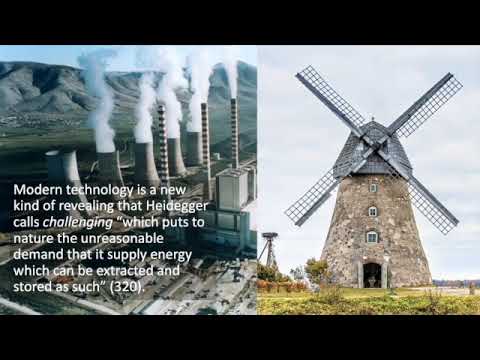
At first glance, modern technology may seem disconnected from the craft of traditional making. For instance, a factory worker operating a machine lacks the intimate knowledge that a carpenter possesses when crafting a chair. Heidegger contrasts traditional modes of farming, which engage with nature, with factory farming, which imposes demands on the soil and environment.
Heidegger introduces the concept of challenging as a defining characteristic of modern technology. This term refers to the unreasonable demand that nature supply energy, which can be extracted and stored. Modern technology treats everything in nature as a resource to be exploited, transforming it into a homogeneous unit of energy.
Heidegger describes modern technology's tendency to reduce everything to a standing reserve—a term that refers to resources waiting to be used. For example, an airplane is not meaningful in isolation; its significance arises from its role within the larger system of air travel. This perspective leads to a dangerous attitude that asserts human control over nature, obscuring the reality that nature must offer something for us to use.
Heidegger warns that this mode of revealing truth through modern technology conceals important aspects of our relationship with the world. It fosters an illusion that everything is a product of human construction, preventing us from encountering the world outside ourselves. This limited truth can be detrimental to human existence, as it neglects the richness and mystery of nature.
To address the dangers posed by modern technology, Heidegger advocates for a return to earlier modes of revealing—Tech and Poesis—that respect and respond to nature. These approaches acknowledge the interconnectedness of human making and the natural world, fostering a relationship that is not objectifying.
Heidegger's reflections on technology challenge us to reconsider our relationship with the world and the implications of modern technological practices. While technology can enhance our lives, it is crucial to remain aware of its potential to obscure deeper truths about our existence and our connection to nature. As we navigate the complexities of modern technology, we must strive to engage with it thoughtfully, recognizing both its capabilities and its limitations.
What are your thoughts on Heidegger's perspective? Does he offer valuable insights into our contemporary relationship with technology, or is he merely resistant to change?