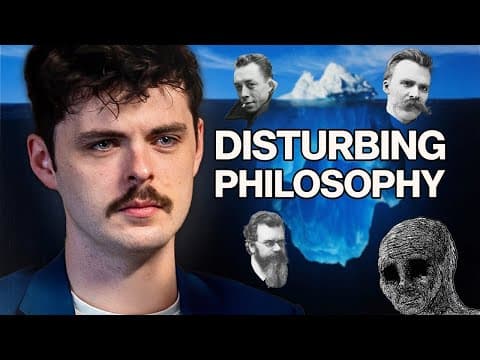
The Existential Crisis Iceberg presents a hierarchy of existential concerns, ranging from the realization of individual complexity to the implications of quantum immortality. This blog post explores each layer, discussing the philosophical and psychological impacts of these concepts on our understanding of existence.
Recently, a fascinating concept known as the Existential Crisis Iceberg has gained traction on platforms like TikTok, where it has garnered millions of views. Originally posted on Reddit by a user named kvic, this iceberg chart categorizes various existential concerns, ranging from the mundane to the profound. In this blog post, we will explore each layer of the iceberg, delving into the philosophical implications and psychological impacts of these existential questions.
At the surface level, we encounter the realization that everyone has a life as complex as our own. This understanding, often referred to as the "s" phenomenon, highlights that every individual, including strangers, is living a rich tapestry of experiences. While this may seem obvious, it can be a profound revelation when we consider that we often view ourselves as the main character in our own narrative, forgetting that others are also navigating their own intricate stories.
As we transition into adulthood, the focus shifts from simple childhood concerns to more complex issues such as taxes, home ownership, and career paths. This shift can lead to anxiety and existential crises as we grapple with the weight of future responsibilities and uncertainties.
One of the more intriguing concepts is Simulation Theory, which posits that our reality could be a computer simulation. This idea, rooted in René Descartes' evil demon hypothesis, suggests that we might be deceived into believing in a tangible world when, in fact, we are living in a simulated environment. Philosopher Nick Bostrom popularized this argument, suggesting that as technology advances, the likelihood of living in a simulation increases. This notion can provoke existential dread as it challenges our understanding of reality and existence.
This fundamental question probes the very nature of existence. The contemplation that there could have been nothing at all can lead to existential discomfort. Whether one concludes that existence is random or divinely orchestrated, the search for meaning can be both enlightening and troubling.
The realization of our mortality is perhaps one of the most straightforward yet impactful existential crises. Acknowledging that life is finite can evoke fear, but it can also instill a sense of urgency and meaning, as some argue that the brevity of life enhances its value.
This concept suggests that our empathy for others may stem from our own self-interest, raising questions about the nature of altruism and morality. If our care for others is merely an evolutionary trait for survival, it complicates our understanding of genuine compassion.
A thought experiment rather than a widely held belief, Last Thursdayism posits that the universe was created last Thursday, complete with false memories. This idea serves as a critique of radical skepticism and challenges our understanding of time and existence.
This notion explores the idea that our consciousness is isolated within our brains, leading to a sense of disconnection from the external world. It raises questions about perception and reality, suggesting that our experiences are mediated by our brain's interpretations.
Nihilism represents a culmination of existential crises, where one concludes that nothing matters. This perspective can arise from questioning the meaning of life, the existence of an afterlife, and the nature of reality itself.
At the depths of the iceberg lies the concept of Quantum Immortality, derived from the many-worlds interpretation of quantum mechanics. This theory suggests that every possible outcome occurs in parallel realities, implying that consciousness continues in branches where one survives. While this idea offers a form of immortality, it also raises ethical and philosophical questions about existence and identity.
The Existential Crisis Iceberg encapsulates a range of profound questions that challenge our understanding of life, reality, and our place in the universe. From the realization of our mortality to the implications of quantum theories, each layer invites us to reflect on the complexities of existence. As we navigate these existential waters, we may find that the journey itself is as significant as the answers we seek.