This blog post examines the argument that atheism cannot provide a rational basis for belief, as proposed by C.S. Lewis. It discusses the implications of materialism on reason, the responses from materialist perspectives, and the potential for non-materialist atheism as a viable alternative.
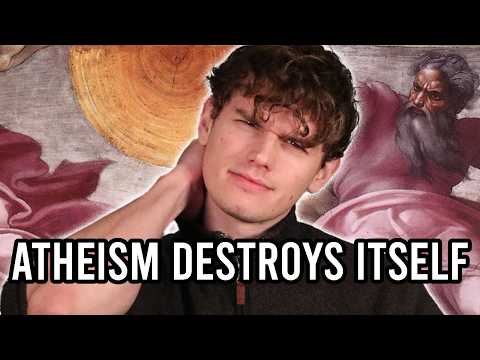
In the ongoing debate between theism and atheism, one argument stands out for its bold claim: that reason cannot exist within an atheist worldview. This assertion, if true, poses a significant challenge not only to atheism but to any rational argument an atheist might present. This blog post will explore this argument, its implications, and the responses it has garnered from both sides of the debate.
The crux of the argument is that under a strictly materialist view of the world, reason and rationality are fundamentally undermined. C.S. Lewis, in his work, suggests that if materialism is true, then all beliefs can be explained solely in terms of non-rational causes. This leads to the conclusion that:
This presents a paradox for materialists: if their worldview is correct, they cannot claim any rational basis for their beliefs, including the belief in materialism itself. This self-defeating nature of materialism raises profound questions about the validity of atheistic arguments.
To understand the implications of this argument, we must first consider the nature of reason itself. Reasoning is not merely a series of logical moves; it is a truth-preserving process that allows us to draw conclusions based on premises. For example, the syllogism:
This logical structure is not just a game; it reflects a deeper truth about the relationships between concepts. If we treat reason as a phenomenon worthy of examination, we begin to see its peculiarities and the challenges it poses to a materialist worldview.
Many materialists have attempted to counter Lewis's argument by suggesting that reason can indeed be grounded in material processes. One notable response comes from Elizabeth Anco, who argues that while our beliefs may have non-rational causes, this does not negate the existence of rational arguments. For instance, a robot programmed to follow logical rules can produce valid conclusions without possessing true understanding or reasoning capabilities.
This perspective suggests that even if our reasoning processes are rooted in material causes, the arguments themselves can still be evaluated for their truth-preserving nature. However, critics of this view argue that it relies on a notion of intentionality that materialism struggles to account for.
Another layer to this discussion is introduced by philosopher Alvin Plantinga, who argues that evolution does not necessarily favor beliefs that are true. Instead, it may favor beliefs that enhance survival and reproduction, which could lead to a set of false beliefs being more advantageous. This raises the question of whether our cognitive faculties are genuinely aimed at discovering truth or merely at ensuring survival.
Materialists like Jerry Fodor counter this by asserting that while evolution selects for survival, it does so through the acquisition of true beliefs about the world. Thus, our reasoning abilities are not merely survival mechanisms but tools for understanding reality.
Despite the challenges posed by Lewis's argument, there exists a spectrum of atheistic thought that does not rely on materialism. Non-materialist atheism posits that while God may not exist, there are still non-material explanations for concepts like reason and logic. Philosophers like Wilfred van Orman Quine argue for the existence of abstract mathematical structures that are indispensable to our understanding of the world, suggesting that these structures exist outside of material reality.
This perspective allows for a rejection of both materialism and theism, opening up a space for a more nuanced understanding of existence that does not require a divine being to ground reason and logic.
The debate surrounding the existence of God and the validity of atheistic arguments is complex and multifaceted. The argument from reason presents a significant challenge to materialism, suggesting that without a rational basis for belief, atheism may be self-undermining. However, responses from materialists and the exploration of non-materialist atheism provide alternative frameworks that allow for a rich discussion on the nature of reason, belief, and existence.
As we continue to explore these philosophical questions, it is essential to broaden our metaphysical imaginations and consider the various positions that exist between the poles of materialism and theism. The conversation is far from over, and each perspective offers valuable insights into the nature of our beliefs and the world we inhabit.