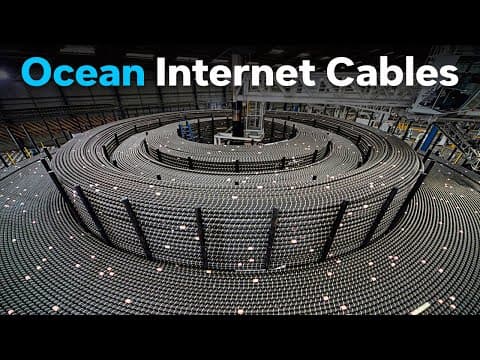
Undersea cables are the backbone of global internet connectivity, with 493 active cables crisscrossing the oceans. These cables, often at risk from natural and human threats, are crucial for data transmission, utilizing advanced technologies to maximize efficiency. As tech giants invest heavily in this infrastructure, the future of internet connectivity remains tied to these underwater networks.
The internet as we know it relies heavily on a hidden network of undersea cables. From streaming videos to sending messages, 99% of all internet traffic travels through these cables. Understanding how they work and their significance in modern life is essential, especially as our dependence on them grows.
According to the authoritative submarine cable map website, there are currently 493 active or under-construction sub-sea internet cables around the world. These cables vary significantly in size and length, from the modest 300-kilometer cable connecting Azerbaijan to Turkmenistan, to the massive 6,600-kilometer Maria cable linking Virginia Beach in the U.S. to Bilbao in Spain. The Maria cable weighs as much as 24 blue whales.
In total, there are approximately 1.5 million kilometers of undersea data wires crisscrossing the globe. The cost of laying these cables is substantial, with estimates suggesting that a typical transoceanic cable can cost between $300 million and $400 million. Despite their relatively slim profile—about the thickness of a garden hose—these cables are engineered with layers of protective materials, including thixotropic jelly around the fiber optic core, plastic sheaths, and copper wiring for power.
Undersea cables are capable of transmitting vast amounts of data. On average, they can handle 100 gigabytes per second, with newer cables expected to reach speeds of 400 gigabytes per second. This impressive capacity is made possible through a sophisticated technique known as dense wavelength division multiplexing. This method allows multiple wavelengths of light to be used simultaneously to convey information, significantly increasing data transmission speeds.
To maintain signal strength over long distances, cables are equipped with repeaters placed every 70 to 100 kilometers along the seabed. These repeaters act as amplifiers, powered by copper conductors carrying up to 10,000 volts of DC. The laying of these cables is a meticulous process, involving specialized ships that spool the cable at a controlled pace of about 10 kilometers per hour. Planning for these routes can take up to a year, as factors such as volcanic activity, earthquakes, and fishing activities are considered.
Despite their robust design, undersea cables are not immune to disruptions. Natural disasters like Hurricane Sandy in 2012 and the Fukushima earthquake in 2011 caused significant outages. However, the majority of disruptions are due to human activities, such as fishing trawlers and ship anchors. Cables near shore are particularly vulnerable, leading to the use of armor plating and burial in dedicated trenches to protect them.
Interestingly, there have been reports of sharks nibbling on undersea cables, highlighting the unexpected challenges these cables face. Additionally, geopolitical tensions pose a risk, with governments warning of potential interference from foreign powers. The NSA's surveillance activities, revealed by whistleblower Edward Snowden, underscore the strategic importance of these cables.
Ownership of undersea cables is a complex issue. Historically, nations or national telecom providers have financed these projects. Currently, AT&T is the largest owner, with a stake in 230,000 kilometers of cables, followed by China Telecom. Many cables are owned by consortia of up to 50 different entities, including tech companies and local governments. This shared ownership model can complicate maintenance and repairs.
In recent years, major tech companies have recognized the limitations of existing undersea cable infrastructure. Companies like Facebook and Google have invested heavily in expanding this network. Facebook alone owns nearly 100,000 kilometers of cables, while Amazon has developed its own extensive private network connecting its data centers across various oceans.
While some may wonder about the impact of satellite internet services like Starlink, undersea cables remain the most efficient and cost-effective means of transmitting large amounts of data over long distances. Even Elon Musk acknowledges that Starlink primarily targets areas lacking high-speed fiber access.
Looking ahead, the future of internet connectivity is still tied to undersea cables. Recent announcements include a joint initiative by Google and Facebook to build a new cable named Apricot, which will connect Singapore, Japan, Guam, the Philippines, Taiwan, and Indonesia by 2024. Additionally, a groundbreaking project called To Africa, a 45,000-kilometer cable linking 33 nations, has been funded by a consortium led by Facebook.
As technology continues to evolve, one must ponder whether mankind's ingenious submarine network will one day become as obsolete as the telegraph. The ongoing investment and development in undersea cables suggest that they will remain a vital part of our global communication infrastructure for the foreseeable future.