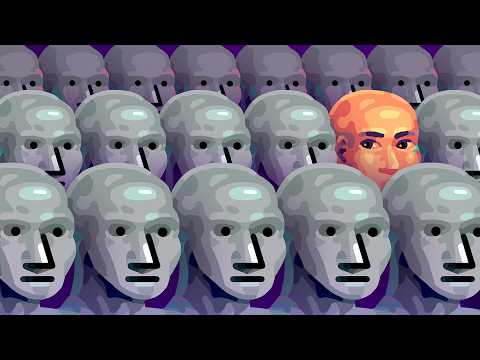
This blog post delves into the philosophical debate surrounding free will, examining arguments from both sides: those who believe free will is an illusion due to deterministic laws of physics, and those who argue for the existence of free will through the concept of emergence and consciousness. Ultimately, it suggests that while the debate continues, the subjective experience of making choices remains significant.
The concept of free will has long been a topic of philosophical debate. Are we truly free to make our own choices, or are we merely following a predetermined path, akin to non-playable characters (NPCs) in a video game? This post explores the complexities of free will, examining the arguments for and against its existence.
Free will is often defined as the ability to make choices independently, shaping our future through our actions. It is a fundamental aspect of human relationships, underpinning our moral and legal systems. However, the question arises: is free will genuinely possible?
One camp in the philosophical debate argues that free will is fundamentally incompatible with the laws of the universe. According to this view, everything we are—our thoughts, decisions, and actions—are the result of physical processes governed by deterministic laws.
Physical Composition: At the core, we are made up of particles—atoms, protons, electrons—that follow the laws of physics without any will or motivation. These particles interact in predictable ways, leading to a chain of causal effects that dictate our behavior.
Predictability of the Universe: Imagine a supercomputer that could analyze every particle in the universe. By applying deterministic laws, it could theoretically predict all future events. If this is true, then our decisions are not truly ours; they were predetermined at the moment of the Big Bang.
Autopilot Existence: This deterministic view suggests that we are merely observers of our lives, with our actions decided long before we were even born. The motions of particles in our brains, which lead us to watch a video or clean our rooms, were set in motion billions of years ago.
Some might argue that quantum mechanics introduces randomness into the equation, suggesting that not everything is predetermined. However, proponents of the no-free-will camp argue that randomness does not equate to free will. Instead, it implies that decisions are made by random processes beyond our control. For instance, if an electron randomly decides to move in one direction, it could trigger a series of events leading to a specific action, but this randomness does not grant us agency.
In contrast, the free will advocates argue that the deterministic view fails to account for the complexity of reality. They propose the concept of emergence, where new properties and behaviors arise from the interactions of simpler components.
Understanding Emergence: Emergence occurs when many small entities combine to create new traits that cannot be explained by examining the individual parts. For example, while H2O molecules are not wet, a collection of them can create the property of wetness.
Layers of Reality: Reality is structured in layers, from atoms to molecules to cells and beyond. Each layer exhibits properties that are not present in the individual components. For instance, while individual neurons do not possess consciousness, the complex network of 80 billion neurons in the human brain gives rise to thoughts, feelings, and ultimately, the sense of self.
Relevance to Free Will: The argument posits that free will should be understood at the level of consciousness and decision-making, rather than at the level of fundamental particles. At this layer, individuals can influence their decisions and actions, suggesting that we are not merely passive observers but active participants in our lives.
So, who is correct in this philosophical debate? The truth remains elusive. While the deterministic perspective presents a compelling argument, the emergence perspective highlights the complexity of human experience.
Even if free will does not exist in the absolute sense, the subjective feeling of making choices is significant. As long as we perceive ourselves as having agency, it impacts how we navigate our lives.
Ultimately, whether or not we have free will, the experience of making decisions is a fundamental aspect of being human. The next time you choose what to watch or how to spend your time, remember that this feeling of choice is what truly matters, regardless of the underlying mechanics of the universe.