This blog post delves into the philosophical argument presented by Thomas Clark, which posits that consciousness is immortal and that death is an epistemic illusion. It explores the implications of this view, including the continuity of subjective experience and the ethical responsibilities that arise from recognizing our shared identity as consciousness.
What happens when we die? Does all experience end forever, or do we live on somehow? Over half of humanity believes that death is not the true end of life, suggesting that beyond this mysterious threshold, something continues. While many secular academics dismiss these beliefs as wishful thinking, the nature of consciousness and existence remains a profound mystery.
The standard view among secular thinkers is that death leads to nothingness, a concept that philosopher Thomas Clark challenges. He argues that the common depiction of death as a plunge into a positive nothingness is a logical fallacy. Clark points out that many secular thinkers mistakenly view death as an eternal state of non-existence, akin to being cast into a dark ocean. This perspective overlooks a fundamental truth about consciousness: it is not merely extinguished at death.
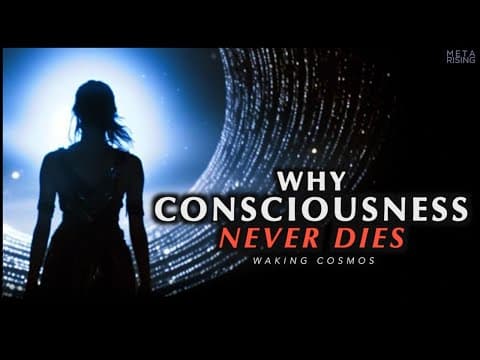
Clark's argument, which we will explore, suggests that consciousness is immortal and that death is an epistemic illusion. He asserts that after death, we should not expect oblivion but rather an enduring sense of existence, manifesting in the form of other conscious beings. This view does not rely on exotic notions of consciousness and holds true even in a purely physical universe governed by unconscious laws.
Before diving deeper into Clark's argument, it is essential to understand the concept of "personal subjective continuity." This term refers to the uninterrupted sequence of experience that conscious beings have throughout their lives. Although we may experience unconscious moments, such as during sleep or anesthesia, these gaps do not exist for us. Our lives are perceived as a continuous stream of awareness, bracketed by birth and death.
Clark argues that just as we have no memory of the time before our birth, we should not expect to be plunged into an eternal night after death. Instead, he posits that death will not mark the end of experience.
To illustrate his argument, Clark presents a thought experiment involving a hypothetical medical procedure called "LifePause." This procedure allows an individual's consciousness to be temporarily halted while undergoing significant changes to their mind and body.
In the first scenario, Alex undergoes moderate changes during LifePause, emerging as "Alex 2.0." He wakes up with a refined version of his original characteristics, feeling as though he has seamlessly continued his conscious journey.
In the second scenario, Alex undergoes radical alterations, becoming "Alex Reborn." Despite significant changes in personality and memories, he experiences no interruption in consciousness. The key insight here is that subjective continuity persists, regardless of the changes.
Now, imagine that instead of undergoing LifePause, Alex dies in a car accident. Later, a new consciousness emerges, which we call "Alex Renewed." Clark argues that there is no difference between the transitions experienced in LifePause and the emergence of Alex Renewed. Both scenarios involve a seamless transition of subjective experience, demonstrating that consciousness continues without a gap.
Clark's argument leads to profound implications about our identity. He suggests that every conscious being is connected through a shared identity of consciousness. This perspective challenges traditional notions of individuality and reincarnation, proposing instead that we continue as consciousness itself.
Recognizing consciousness as our primary identity carries significant ethical implications. It compels us to consider the experiences of all conscious beings and to strive for the reduction of suffering and the promotion of happiness. This view negates the rationale for retributive punishment and highlights the interconnectedness of all conscious experiences.
In conclusion, Clark's argument presents a compelling case for the immortality of consciousness. Death, rather than being an end, is more accurately viewed as a radical refreshment of subjectivity. We are part of a continuous experience of existence, and while we may experience death, it is ultimately an abstraction. There is no life after death because there is no death; consciousness persists in various forms throughout the universe.
This exploration of consciousness invites us to reflect on our shared identity and the ethical responsibilities that arise from it. As we navigate our lives, we must consider how to improve the experiences of all conscious beings within our reach, recognizing that we are all interconnected in this profound journey of existence.