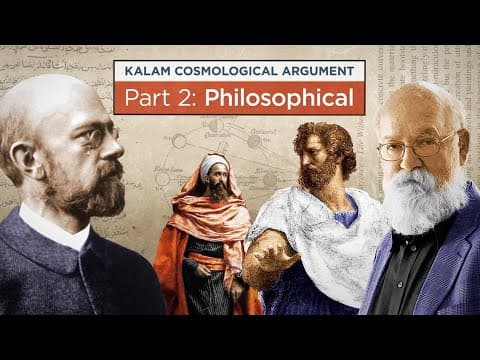
The Kalam Cosmological Argument posits that the universe must have a beginning, leading to the conclusion that it requires a cause, which many argue points to the existence of God. This post examines the philosophical implications of an eternal universe versus a universe with a beginning, using arguments from Al Ghazali and examples like Hilbert's hotel to illustrate the absurdities of infinity.
Did the universe have a beginning, or has it existed from eternity past? This fundamental question not only intrigues scientists but also philosophers. If the universe did have a beginning, it raises another critical question: did the universe have a creator? In this post, we will delve into the philosophical aspects of this argument, building on the scientific discussions from part one.
Historically, philosophers have debated the nature of the universe. Aristotle believed that the universe was eternal, existing without a beginning. However, the philosopher Al Ghazali presented a compelling counterargument. He argued that if the universe did not have a beginning, it would imply an infinite number of past events in its history. This leads to significant philosophical problems, as the existence of an actually infinite number of past events is considered metaphysically impossible.
To illustrate the problems associated with infinity, mathematician David Hilbert proposed a thought experiment involving a hotel with an infinite number of rooms, all occupied. When a new guest arrives, the manager can still accommodate them by moving each current guest to the next room number. This seemingly paradoxical situation demonstrates that even when all rooms are full, it is possible to create a vacancy.
Furthermore, if an infinite number of new guests arrive, the manager can again accommodate them by moving each guest to a room with a number that is double their current room number. This results in all odd-numbered rooms becoming vacant, allowing the new guests to check in, despite the hotel being full initially.
These scenarios highlight the absurdities that arise when dealing with actual infinities. For instance, if all guests in odd-numbered rooms check out, an infinite number of guests leave, yet the total number of guests remains unchanged. Conversely, if only a finite number of guests check out, the same number of guests can leave, leading to contradictory outcomes.
Ghazali offers a second argument against the notion of an eternal universe. He uses the example of Saturn and Jupiter, where for every orbit Saturn completes, Jupiter completes two. If both planets have been orbiting the Sun from eternity past, one would expect that the number of orbits completed would differ over time. However, both would have completed an infinite number of orbits, which seems absurd.
This leads to the conclusion that if the universe has always existed, it would imply an infinite series of past events. This is akin to a sequence of dominoes falling, where the last domino represents today. If an infinite number of dominoes must fall before reaching today, then today could never actually arrive.
Ghazali concludes that the infinite does not exist in reality. It is not found in nature, nor does it provide a legitimate basis for rational thought. Instead, infinity remains an abstract idea.
Some objections to Ghazali's arguments arise. One common objection is that, unlike the rooms in Hilbert's hotel, past events do not all exist simultaneously. However, this can be countered by imagining a hotel that has been under construction from eternity past, with one room added each year. If the past were infinite, this hotel would also contain an actual infinite number of rooms, which is absurd.
Another objection posits that actual infinities do exist, particularly in mathematics. However, this assumption is highly disputed among philosophers, many of whom reject the notion that mathematical entities exist in the same way physical objects do.
If Ghazali's arguments hold true, then the universe cannot be eternal; it must have a beginning. Intuitively, we understand that anything that begins to exist requires a cause. This leads us to the conclusion that the universe has a cause for its existence.
Atheist philosopher Daniel Dennett suggests that the universe caused itself, but this notion is incoherent. For the universe to cause itself, it would need to exist before it existed. Therefore, the cause of the universe must be something outside of it—spaceless, timeless, immaterial, and immensely powerful, akin to the concept of God.
In summary, the Kalam Cosmological Argument presents a profound philosophical inquiry into the nature of existence, challenging us to consider the implications of an eternal universe versus one with a definitive beginning.