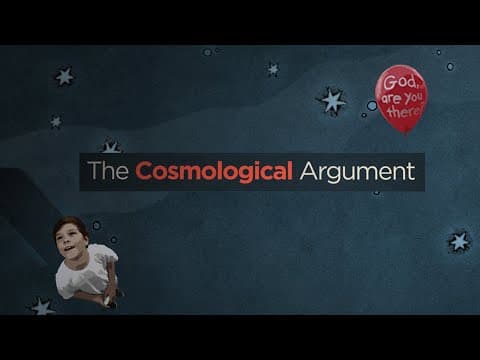
The Kalam Cosmological Argument posits that the universe has a cause based on two premises: everything that begins to exist has a cause, and the universe began to exist. Scientific evidence supports these premises, leading to the conclusion that the universe's cause is likely beyond the physical realm, aligning with the concept of God.
The question of whether God exists or if the material universe is all that has ever existed is a profound one. One philosophical approach to addressing this question is the Kalam Cosmological Argument. This argument is structured around two main premises:
From these premises, it follows that the universe has a cause.
The first premise asserts that everything that begins to exist must have a cause. This idea is intuitive and aligns with our everyday experiences. The notion that something could spontaneously come into existence without a cause is more implausible than believing in magic. At least in magic, there is a magician and a hat involved.
If it were possible for something to arise from nothing, we would expect to witness such occurrences regularly. However, our observations and scientific evidence consistently support the idea that if something begins to exist, it must have a cause.
The second premise questions whether the universe itself began to exist or if it has always existed. Traditionally, some atheists have argued that the universe is eternal, simply existing without a beginning. However, this perspective is challenged by the Second Law of Thermodynamics, which states that the universe is gradually running out of usable energy. If the universe had existed forever, it would have exhausted its usable energy by now.
The idea of a universe with a definite beginning is further supported by significant scientific discoveries:
This monumental discovery reshaped our understanding of the cosmos, although it faced skepticism from those who preferred the idea of an eternal universe.
Despite the initial resistance, alternative models proposing an eternal universe have consistently failed to withstand scrutiny. Recent work by cosmologists Arvind Borde, Alan Guth, and Alexander Vilenkin has demonstrated that any universe that has been expanding on average throughout its history cannot be eternal in the past; it must have an absolute beginning. This conclusion applies even to hypothetical multiverse models.
Given the scientific evidence supporting both premises of the Kalam Cosmological Argument, it is reasonable to conclude that the universe has a cause. Since the universe cannot cause itself, its cause must transcend the physical realm. This cause is likely to be spaceless, timeless, immaterial, uncaused, and unimaginably powerful—attributes that align closely with the concept of God.
In summary, the Kalam Cosmological Argument provides a compelling framework for understanding the existence of God through a scientific lens, suggesting that belief in God is not only reasonable but also supported by contemporary scientific findings.