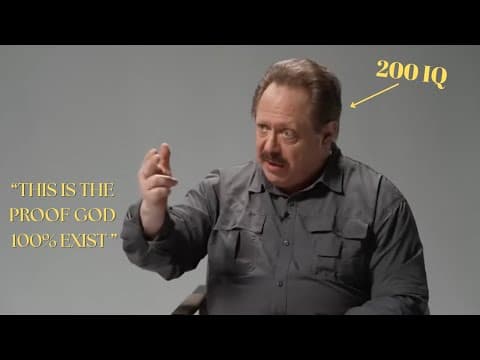
Chris Langan, with an IQ of 200, presents a logical argument for the existence of God, asserting that reality's identity necessitates a divine being. His insights connect philosophical concepts with traditional religious attributes, suggesting that God is both a logical necessity and a personal entity.
In the quest for understanding the universe and our place within it, one of the most profound questions arises: Does God exist? Chris Langan, a man with one of the highest IQs ever recorded at 200, offers a compelling argument that transcends mere faith, proposing that the existence of God is a fundamental necessity of reality itself. This blog post delves into Langan's insights, exploring how he uses pure logic to establish a framework for understanding God.
To appreciate Langan's perspective, it's essential to understand the context of intelligence. Most individuals have an IQ around 100, while scores in the 140 range indicate genius-level intellect. Historical figures like Einstein and Newton scored between 160 and 190, making Langan's score of 200 exceptionally rare, placing him among the smartest individuals in history. This extraordinary intellect informs his approach to philosophical and theological questions.
Langan begins his argument with a fundamental insight about reality: for reality to exist, it must have an identity. This identity is not merely a philosophical abstraction; it is a logical necessity. When we refer to reality, we are naming something that possesses distinct characteristics. This concept of identity forms the bedrock of Langan's proof for God's existence.
Langan draws parallels between his concept of identity and the biblical declaration of God to Moses at the burning bush, where God states, "I am that I am." This assertion of identity is central to Langan's argument, as he posits that God embodies identity itself. His theory, known as the CTMU (Cognitive-Theoretic Model of the Universe), provides a mathematical structure that underpins reality, allowing for the exploration of its properties.
Once Langan establishes the identity of reality, he examines its properties. He finds that these properties align closely with traditional descriptions of God found in major world religions. Key attributes include:
These characteristics suggest that God is not just a distant figure but an integral part of the fabric of reality.
Langan introduces the simulation hypothesis to further illustrate his argument. This hypothesis posits that the reality we perceive may be a simulation, akin to a computer program. He explains that just as a display contains states that require processing to change, our reality also necessitates an underlying process to maintain coherence over time. This processing functionality, he argues, is provided by God.
In Langan's view, God serves as the divine processor that allows for the continuity and coherence of existence. He explains that every individual has both an internal and external state, and to understand how these states evolve over time, one must recognize the role of God in facilitating this change. This perspective emphasizes that God is not merely a concept but a necessary entity for the functioning of reality.
Langan concludes his argument by highlighting the personal nature of God. He asserts that humans are created in the image of God, meaning that each person reflects a mapping of the divine identity. This relationship is deeply personal, suggesting that individuals can establish a connection with God, who actively engages with humanity.
What makes Langan's argument particularly compelling is its ability to bridge the gap between cold logic and spiritual meaning. He presents a case for God's existence that is both rationally necessary and profoundly personal. By grounding his insights in logical reasoning, Langan invites readers to reconsider the relationship between faith and reason, suggesting that belief in God can be both an intellectual and emotional experience.
Chris Langan's exploration of God's existence through the lens of logic offers a unique perspective that challenges conventional views. By establishing a framework that connects identity, properties of the divine, and the necessity of a processing entity, Langan provides a thought-provoking argument for the existence of God. His insights encourage a deeper understanding of reality and our place within it, inviting readers to reflect on the intersection of logic, faith, and personal experience.