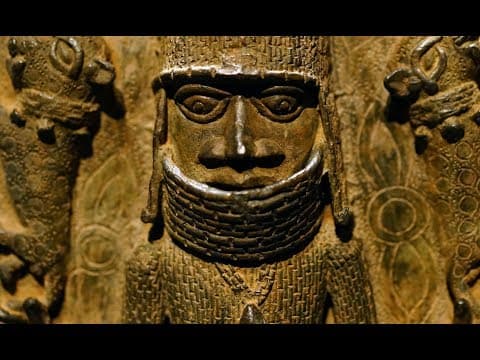
The Kingdom of Benin, founded around 900 AD in present-day Nigeria, is renowned for its intricate bronze plaques that symbolize the power and wealth of its rulers. This blog post delves into the significance of these artworks, their historical context, and the evolution of Benin art, particularly during the reign of Oba Ewuare II.
The Kingdom of Benin, located in present-day Nigeria, boasts a rich history that dates back to around 900 AD. At its zenith, the kingdom was a powerful entity, controlling an area comparable to New England and home to approximately two million inhabitants. The current reigning king, Oba Ewuare II, traces his lineage back to around 1250 AD, highlighting the enduring legacy of this remarkable kingdom.
In examining the Benin plaques, we encounter the Oba, or king, adorned in magnificent regalia that signifies his authority. The Oba's crown, crafted from coral beads, features a tall basketry projection known as an oro projection, a symbol of leadership. His attire includes a tunic made entirely of coral and an imported damask skirt, with coral embellishments on his ankles and arms. Most notably, he wears the bead of rule on his chest, a powerful emblem of his sovereignty.
The coral's deep orange-red hue is striking, and the king is depicted holding leopards, which serve as metaphors for his power. The leopard, recognized as the fastest and most ferocious creature in the forest, embodies the king's strength. Additionally, the presence of mudfish around his waist symbolizes resilience, as these creatures can survive in two worlds by burying themselves in mud during dry seasons.
The frontal and symmetrical posture of the Oba in the plaques reflects a deliberate aesthetic choice prevalent in Benin art. This posture, while uncomfortable to mimic, emphasizes the stylized representation of the king. As we explore other plaques, we observe a gradual evolution in the artists' comfort with depicting movement, showcasing a dynamic progression in their artistic expression.
Originally, the plaques would have gleamed brilliantly in the sunlight, captivating visitors to the court. However, many of these artworks appear brown in European and American collections due to the practice of oiling them, which was favored by European collectors. This oiling has affected the metal's surface, leading to concerns about losing intricate details if the oil is removed.
The process of casting bronze is complex, requiring highly skilled artisans. As we examine various plaques, we can trace the artists' growing confidence in their craft over time. A common motif found in these artworks is the river leaf, which connects to the coral worn by the king and symbolizes wealth, as it is associated with Olokun, the god of wealth residing beneath the river.
Visitors to the court in Benin City would have encountered a magnificent palace, complete with an audience hall adorned with these impressive plaques. The plaques were strategically placed around the pillars supporting the hall's open ceiling, allowing sunlight to illuminate the artworks. This arrangement would have created a stunning visual experience for anyone entering the space, reinforcing the king's power and wealth.
Imagine walking into a hall reminiscent of a modern presidential office, but instead of dollar bills, the walls are wrapped in bronze plaques symbolizing immense wealth. The sight of the Oba, dressed in gleaming coral, would have been a breathtaking spectacle, designed to dazzle and impress.
The presence of Benin plaques in museums across the United States and Europe can be traced back to a tragic chapter in the kingdom's history. In 1897, a trade dispute led to a war between Britain and Benin, resulting in the British invasion of Benin City. The city was razed, and a significant portion of the royal treasury was looted and sold at auction in Europe. The beauty of Benin art captivated collectors, leading to the widespread acquisition of these plaques by museums worldwide.
Among the plaques, we find a variety of sizes and styles, with narrow plaques designed to complement wider ones, often sheathing columns. One notable plaque features a solitary mudfish, showcasing the early artistic techniques characterized by low relief. As artists gained confidence, they began to experiment with higher relief and more intricate designs.
For instance, a later plaque depicts three figures, often seen in Benin art, arranged in a triadic symmetry. The central figure, likely a warrior, is adorned with a warrior's bell and a leopard tooth necklace, indicating his affiliation with the Oba's militia. The movement and animation of the figures become more pronounced, reflecting the artists' growing mastery of their medium.
As we analyze another plaque featuring three officials, we note that all figures are of equal size, a departure from earlier works where hierarchical importance was visually represented by size. The figure wearing a high coral collar, known as an odigba, signifies a high-ranking court member, while the others display their status through various emblems of authority.
The intricate details of their regalia, including different types of bells and textiles, reveal the complexity of Benin art. The figures are depicted in a procession towards the king, with one holding an offering box, symbolizing the exchange of gifts or taxes between the king and his subjects.
The evolution of Benin art, as seen through the more than 850 plaques, illustrates the artists' development over time, both in technique and composition. Commissioned by two kings, Esigie and his son Orhogbua, these artworks were intended to convey the grandeur of the king's power and to mend relationships within the court.
In the museum, we view these plaques frontally, but in the palace, they would have surrounded visitors, creating a vibrant atmosphere that brought the figures to life. The audience with the Oba was not just a meeting; it was an experience steeped in history, art, and the enduring legacy of the Kingdom of Benin.