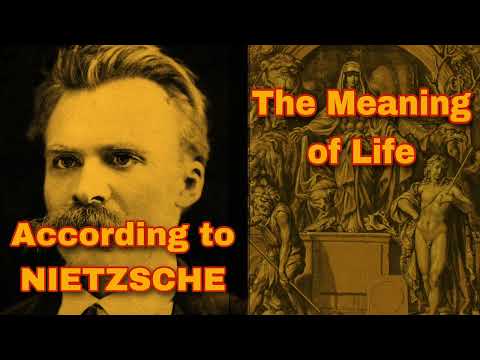
This blog post delves into Nietzsche's philosophy regarding the meaning of life, emphasizing the importance of the body, the concept of Will to Power, and the rejection of traditional spiritual beliefs. It discusses how Nietzsche's ideas challenge conventional views on existence, morality, and the pursuit of a fulfilling life, ultimately advocating for a life-affirming approach that embraces individuality and the transient nature of existence.
In the realm of philosophy, few figures have sparked as much debate and introspection as Friedrich Nietzsche. His exploration of the meaning of life, particularly through the character of Zarathustra, offers profound insights into existence, morality, and the human condition. This blog post aims to unpack Nietzsche's philosophy, focusing on his views about the body, the concept of Will to Power, and the rejection of traditional spiritual beliefs.
Nietzsche's philosophy begins with a fundamental understanding of the body. Zarathustra, a central figure in Nietzsche's work, emphasizes that the spirit is merely a construct, a "quasi-spirit" that does not hold the permanence we often attribute to it. This perspective challenges the long-standing philosophical and religious notions that prioritize the immaterial over the physical. Nietzsche argues that our identity and existence are rooted in our physical being, which is subject to the laws of nature and impermanence.
Nietzsche critiques the traditional spiritual views that have dominated Western thought, particularly those stemming from Christianity. He posits that the belief in an immortal soul and a permanent spiritual realm detracts from the richness of embodied life. Instead of seeking permanence in the spiritual, Nietzsche urges us to embrace our physical existence, recognizing that life is inherently transient and that our experiences are shaped by our bodily nature.
At the core of Nietzsche's philosophy is the concept of the Will to Power. This idea suggests that the fundamental driving force of life is not merely survival or existence but rather a desire to assert and enhance one's power and influence. Nietzsche argues that all living beings strive to overcome obstacles, assert their will, and create meaning in their lives.
Nietzsche's view of life as a creative force contrasts sharply with the notion of life as a struggle for mere survival. He believes that life is about expansion, domination, and the pursuit of greatness. This perspective encourages individuals to embrace their instincts and desires, viewing them as expressions of their Will to Power. In this light, morality becomes a means of self-overcoming, where individuals challenge their limitations and strive for personal growth.
Nietzsche's philosophy is marked by a rejection of dogmatic beliefs, including those found in traditional religions. He warns against the dangers of blind faith, asserting that faith in any ideology, including his own, can lead to a form of intellectual complacency. Instead, he advocates for a personal journey of self-discovery, where individuals must forge their own paths and create their own values.
In a notable passage, Zarathustra reflects on the nature of poets and their tendency to create parables that may not reflect the truth. Nietzsche acknowledges that he, too, is a poet and thus cannot be entirely trusted. This self-awareness highlights the complexity of human thought and the inherent limitations of language in capturing the essence of existence.
Nietzsche's philosophy ultimately leads to an affirmation of life, even in the face of its inherent impermanence. He encourages individuals to embrace their mortality and view death not as a source of despair but as a motivator to live fully. By recognizing the transient nature of existence, we can appreciate each moment as precious and meaningful.
For Nietzsche, the good life is one that embraces the Will to Power and seeks to create something greater than oneself. This involves living authentically, pursuing one's passions, and engaging with the world in a way that reflects individual values and desires. Nietzsche's ideal individuals, such as Goethe and Napoleon, exemplify this approach, as they embody the spirit of creativity and self-assertion.
Nietzsche's exploration of the meaning of life challenges us to reconsider our beliefs about existence, morality, and the nature of reality. By emphasizing the importance of the body, the Will to Power, and the rejection of dogma, Nietzsche invites us to embrace life in all its complexity. His philosophy encourages us to live authentically, confront our mortality, and create meaning in a world that often seems indifferent to our struggles. In doing so, we can find a deeper appreciation for the fleeting moments that make up our existence and strive to leave a lasting impact on the world around us.