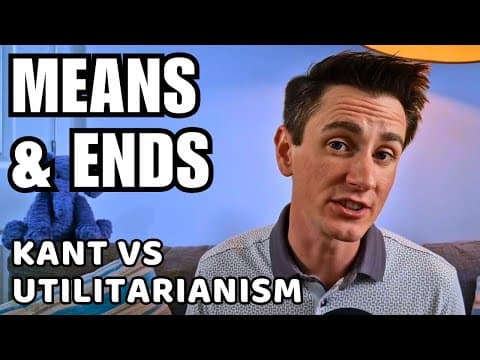
This blog post delves into the philosophical debate surrounding the question of whether the ends justify the means, contrasting the views of Kant and utilitarianism, particularly through the lens of the trolley problem.
The question "Does the end justify the means?" is a central theme in moral philosophy, prompting deep reflection on the nature of ethics and human actions. To understand this question, we must first clarify what is meant by "end" and "means."
The end refers to the final result of an action—essentially, what one hopes to achieve. In contrast, the means are the actions taken to reach that end. This distinction is crucial in evaluating moral decisions.
A classic illustration of this dilemma is the trolley problem. Imagine a scenario where a trolley is speeding towards five unsuspecting individuals on the track. You are in a position to intervene by pushing a large person off a bridge onto the track, which would stop the trolley and save the five lives. However, this action would result in the death of the large man. Here, the moral question arises: does saving five lives justify the act of killing one?
Philosopher Immanuel Kant argues against the notion that the end justifies the means. For Kant, every human being is an end in themselves, possessing inherent dignity that must be respected. He posits that using someone merely as a means to achieve an end is morally wrong. This principle is encapsulated in his second formula of the Categorical Imperative, known as the Formula of Humanity or the Formula of the End in Itself. According to Kant, one should never push a large man off a bridge, as it violates the respect owed to him as a human being.
In stark contrast to Kant's deontological ethics, utilitarianism—particularly as articulated by Jeremy Bentham—embraces a consequentialist approach. Bentham's principle of utility focuses on maximizing happiness. In this framework, if pushing the large man off the bridge leads to a greater overall happiness (saving five lives), then it is deemed acceptable. Thus, Bentham would argue that we are morally obligated to push the large man off the bridge to achieve the greater good.
However, John Stuart Mill, another prominent utilitarian, introduces a more nuanced perspective through rule-utilitarianism. Mill suggests that we should adhere to rules that generally promote the greatest happiness. In this context, a rule such as "treat others as ends, not as means" could be considered essential for maximizing happiness in the long run. This implies that even if pushing the large man off the bridge might save lives in a specific instance, it could lead to a breakdown of trust and respect in society if such actions were normalized.
Furthermore, preference utilitarianism expands the discussion by emphasizing the importance of considering the preferences of individuals affected by our actions. This approach advocates for respecting others' preferences not to be treated as mere means, thereby reinforcing the idea that moral decision-making should account for the dignity and respect owed to all individuals.
The debate over whether the ends justify the means is complex and multifaceted, with significant implications for moral philosophy. Kant's insistence on the inherent dignity of individuals stands in contrast to the utilitarian focus on outcomes and happiness. As we navigate moral dilemmas, such as the trolley problem, it becomes evident that our ethical frameworks shape our decisions and the values we uphold in society. Understanding these perspectives allows for a richer engagement with the moral questions that define our actions and their consequences.