This blog post delves into the philosophical implications of memory, existence, and the nature of the past, questioning how future generations will perceive our present and the legacy we leave behind, all while exploring concepts like Last Thursdayism and the Second Law of Thermodynamics.
In a thought-provoking exploration of memory and existence, Michael from Vsauce presents intriguing ideas about how we perceive the past and how future generations might remember us. This discussion begins with a fascinating anecdote about Terry, the dog who played Toto in The Wizard of Oz, and leads into deeper philosophical questions about the nature of reality and memory.
Terry, credited as Toto in The Wizard of Oz, was buried by her owner Carl Spitz in 1945. However, her grave was disturbed in 1958 when the Ventura Highway was constructed, and her remains have never been found. In 1998, a cenotaph was erected in her honor at Hollywood Forever Cemetery, but it serves as an empty tomb, a reminder of how memory can be preserved even when the physical remains are lost.
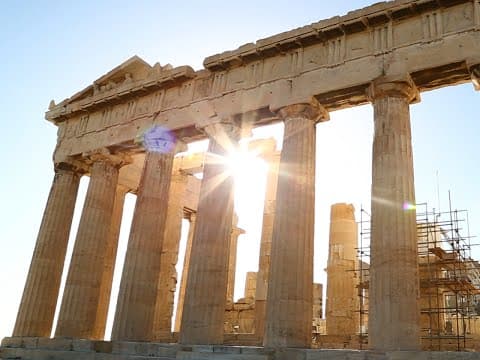
Michael reflects on his recent trip to Greece, where he visited historical sites like the Acropolis and the Lion Gate. These ancient structures prompt him to ponder how future archaeologists will interpret the remnants of our current society. Will they accurately piece together our history, or will they be left with fragmented memories of who we were?
This leads to a profound question: how can we be sure that the past truly happened as we remember it? Michael introduces the concept of Last Thursdayism, a philosophical idea suggesting that the universe could have been created last Thursday, with all our memories and experiences fabricated. While this notion lacks followers or rituals, it raises the challenge of proving it wrong, as any evidence can be dismissed as part of the fabricated history.
Many believe that for a theory to be scientific, it must be falsifiable. However, Last Thursdayism falls into the realm of philosophy, where Occam's Razor serves as a guiding principle. This principle suggests that when faced with competing explanations, one should choose the simplest one. In this case, it is more reasonable to believe that ancient structures were built in the past rather than assuming they were created last Thursday.
Another philosophical tool, humorously named Newton's Flaming Laser Sword, states that if something cannot be settled by experiment, it is not worthy of debate. This principle emphasizes the limitations of our understanding of the past, as it cannot be tested or observed in the same way as physical phenomena like gravity or light.
As we consider our place in history, Michael raises the question of whether future generations will remember us. He cites Ira Glass's challenge to name ten people from the 15th century, highlighting how many historical figures fade into obscurity over time. Despite our efforts to document our lives, apathy may obscure our contributions to history.
However, there is a legacy that is irreversible and unforgettable: our contribution to the universe's entropy. The Second Law of Thermodynamics states that energy will inevitably spread out and disperse. While we may not be remembered in history books, the energy we expend and the entropy we create during our lives will leave a lasting mark on the universe.
Michael explains that many scientists believe the universe will eventually reach a state of thermodynamic equilibrium, known as the "Heat Death," where energy is evenly distributed, and no processes can occur. This state is estimated to happen in about 8 googol years, and our existence contributes to this inevitable outcome.
Interestingly, Michael notes that those who choose to be less active may, in a way, be helping to prolong the universe's life. By conserving energy and limiting their contribution to entropy, they are theoretically postponing the Heat Death of the universe, albeit by an almost negligible amount.
In conclusion, the exploration of memory, existence, and the nature of the past raises profound questions about how we are remembered and the legacy we leave behind. While history may forget us, our contributions to the universe's entropy are undeniable and everlasting. As we navigate our lives, we should consider not only how we are perceived today but also the impact we have on the universe as a whole. Thanks for joining this philosophical journey into the nature of existence and memory.