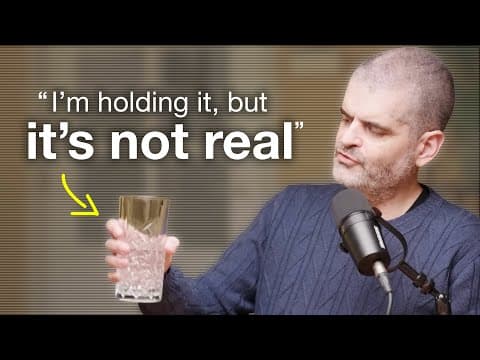
Dr. Bernardo Kastrup presents a compelling argument for analytic idealism, suggesting that reality is fundamentally mental rather than physical. He challenges traditional views of consciousness and matter, proposing that our perception of the physical world is merely a representation of a deeper, unified consciousness. This perspective reshapes our understanding of free will, the nature of existence, and the interconnectedness of all beings.
In a thought-provoking discussion, Dr. Bernardo Kastrup, a former CERN scientist and a leading voice in the philosophy of mind, presents a radical perspective on the nature of reality. He argues that what we perceive as the physical world is not independent of our consciousness but is instead a manifestation of a deeper, unified mental reality. This blog post delves into Kastrup's insights, exploring the implications of his philosophy known as analytic idealism.
Kastrup begins by challenging the conventional understanding of matter. He posits that matter is not a fundamental aspect of reality but rather a representation of consciousness. According to him, when there are no living beings to observe, there is no matter. This assertion leads to the idea that what we perceive as solid objects, like a glass, are merely mental qualities experienced within consciousness.
To illustrate his point, Kastrup uses the metaphor of an airplane's dashboard. The dashboard displays information about the external environment, such as the sky and clouds, but these representations only exist when there is a pilot (or observer) to interpret them. Similarly, he argues that matter is a dashboard representation of a deeper reality that exists independently of our perception. Without conscious beings to observe, the physical world, as we understand it, does not exist.
Kastrup emphasizes that our senses act as instruments that report data about the world, but this data is already processed by the time we become aware of it. The brain, from an outside perspective, appears as a physical structure, but from the inside, it is a theater of thoughts, emotions, and memories. This duality suggests that the inner and outer worlds are two sides of the same event, viewed from different angles.
Under analytic idealism, Kastrup argues that what we call matter is simply how mental activity appears when observed from a different perspective. This perspective shift has profound implications for science, which has traditionally focused on finding patterns in the behavior of matter without addressing the fundamental question of why matter exists in the first place.
Kastrup challenges the notion of individual separation, proposing that there is only one universal consciousness. Each of us is a localized expression of this consciousness, experiencing reality from a unique point of view. This perspective suggests that our sense of individuality is an illusion, a useful construct that arises from dissociation within the universal mind.
When discussing free will, Kastrup presents a nuanced view. While we make choices, these choices are determined by our internal conditions and the structure of our consciousness at any given moment. He argues that even the universal mind does not know in advance what choices will be made, as the universe is computationally irreducible. This means that the only way to know the outcome of a choice is to let it unfold.
Kastrup further explores the concept of time, suggesting that it is not a fundamental aspect of reality but rather a construct we generate to organize our experiences. This view leads to the idea that birth and death are not absolute truths but transitions in appearance. Our lives, rather than being linear journeys, may be expressions of an ongoing presence of consciousness.
In this framework, consciousness is not something that is created by the brain; rather, the brain is what consciousness looks like when observed from the outside. This reinterpretation of the relationship between mind and matter opens up new avenues for understanding phenomena that traditional materialism struggles to explain, such as telepathy and other anomalous experiences.
Dr. Kastrup's insights challenge us to reconsider our understanding of reality. By viewing consciousness as the fundamental aspect of existence, we can begin to see the interconnectedness of all beings and the illusion of separation. This perspective encourages us to recognize that we are not isolated entities but rather facets of a single, universal consciousness.
In this model, free will is not about controlling reality but about participating in the unfolding of consciousness. Each choice we make is a reflection of our unique expression of this universal mind, revealing the deeper truths of existence. As we explore these ideas, we may find that the ordinary moments of life shimmer with meaning, reminding us that we are part of a vast, interconnected reality.