This blog post delves into the philosophical and scientific implications of the free will theorem, discussing its relationship with determinism, randomness, and moral responsibility, while presenting arguments in favor of free will and critiquing the deterministic perspective.
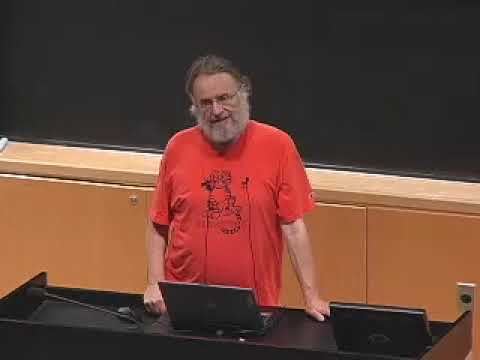
In the final lecture of the series on the free will theorem, John Conway discusses the philosophical consequences and scientific implications of free will. This lecture aims to explore the relationships between determinism, randomness, and free will, while also addressing the challenges of proving or disproving these concepts.
The free will theorem posits that if humans possess free will, then elementary particles must also exhibit a form of free will. This assertion leads to a complex discussion about the nature of determinism and the implications for both science and philosophy. Conway emphasizes that the exploration of free will is not merely a philosophical endeavor but has significant scientific ramifications as well.
Conway begins by addressing the deterministic perspective, which suggests that every event or action is determined by preceding events in accordance with the laws of nature. He argues that if the universe were to replay itself with the same initial conditions, free will would not exist, leading to a deterministic view of the world. This raises the question of whether one can logically argue against a determinist's position.
Conway introduces the concept of consistency proofs, which demonstrate that certain systems can be consistent without being true. He provides examples from geometry and set theory to illustrate that consistency does not equate to truth. For instance, non-Euclidean geometry can be shown to be consistent, yet it makes different assertions than Euclidean geometry. Similarly, the consistency of determinism does not imply that it is true.
The discussion transitions to Gödel's theorem, which states that truth cannot be equated with provability within a formal system. Conway draws an analogy between this theorem and the free will theorem, suggesting that if particles exhibit free will, their behavior cannot be fully explained by deterministic laws. This leads to the idea that free will may exist in a realm beyond mechanical explanations.
Conway challenges the traditional view that randomness is the opposite of determinism. He argues that both randomness and determinism exist on the same spectrum, with free will occupying a distinct position. He posits that free decisions made by particles cannot be explained by random numbers or deterministic laws, suggesting a unique form of agency.
The implications of free will extend to moral responsibility. If free will exists, individuals can be held accountable for their actions. However, if actions are determined by randomness or deterministic laws, the concept of moral responsibility becomes problematic. Conway emphasizes that understanding free will may open the door to discussions about accountability and ethics.
Conway presents several arguments supporting the existence of free will:
Scientific Experimentation: The assumption of free will is fundamental to scientific inquiry. If scientists could not freely choose their experiments, the validity of scientific assertions would be undermined.
Surprise Argument: If the assumption of free will implies surprising outcomes in quantum mechanics, this serves as evidence for its existence. The unexpected nature of quantum events suggests that they cannot be fully predicted by deterministic laws.
Existence of Free Will: The assumption that humans possess free will provides a plausible explanation for the non-deterministic behavior observed in quantum mechanics. If particles have a degree of free will, it follows that humans, composed of these particles, may also possess free will.
Conway argues that there is no compelling evidence for determinism, particularly in light of advancements in quantum mechanics. He critiques the belief that physics is inherently deterministic, noting that this perspective has not held true for over eighty years. He challenges the notion of time reversibility in physics, asserting that the behavior of systems does not support a deterministic framework.
In conclusion, Conway asserts that while free will cannot be definitively proven, it remains the most reasonable explanation for the observed phenomena in both philosophy and science. He encourages a belief in free will, stating that there is no compulsion to accept determinism, especially given the lack of evidence supporting it. The exploration of free will continues to be a vital area of inquiry, bridging the gap between philosophical thought and scientific understanding.