In a recent debate, a Buddhist and a Christian engage in a deep philosophical discussion about the validity of their worldviews. The Buddhist argues for the empirical basis of Mahayana Buddhism, emphasizing the Four Noble Truths and the transient nature of reality. The Christian counters with critiques of Buddhism's coherence and moral implications, ultimately defending the truth of Christianity. The conversation highlights the complexities of belief, knowledge, and the nature of reality.
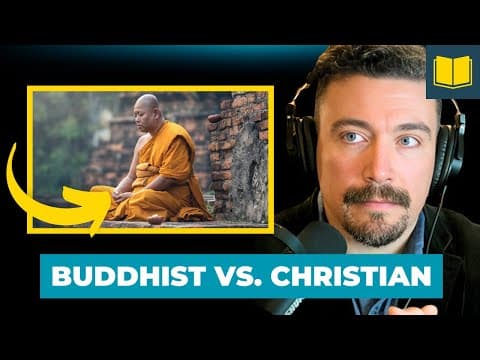
In a recent debate hosted by the Think Institute, a Buddhist and a Christian engaged in a thought-provoking discussion about their respective worldviews. The conversation revolved around the validity of Buddhism and Christianity, with each participant defending their beliefs while challenging the other's perspective.
The debate's central thesis was clear: the Buddhist aimed to defend the proposition that their non-Christian worldview is true while asserting that Christianity is false. The Christian, on the other hand, sought to defend the truth of Christianity and engage in a meaningful dialogue.
The Buddhist participant began by outlining their worldview, emphasizing that it is complex and consists of a set of beliefs rather than a single doctrine. They identified as a Mahayana Buddhist, which they described as a sect that philosophically elaborates on the fundamentals of Buddhism.
The Buddhist explained the core teachings of Buddhism, particularly the Four Noble Truths:
The Buddhist argued that the reliability of this path is grounded in three notions about the nature of reality:
To support their claims, the Buddhist asserted that empirical evidence demonstrates the transient nature of reality. They argued that everything we can observe is characterized by change and that even our senses, which we rely on for knowledge, are themselves transient. This led to a discussion about the reliability of sense perception and the implications of radical skepticism.
The Christian participant challenged the Buddhist's assertions, questioning the reliability of a worldview that admits uncertainty about its own beliefs. They pointed out that if the Buddhist's method of verification is unreliable, then the conclusions drawn from it could also be questionable.
The Christian emphasized that the Buddhist's skepticism undermines their claims to knowledge. They argued that if one cannot know anything for certain, then even the belief in transience becomes problematic. The Christian posited that a worldview must provide a solid foundation for knowledge and truth, which they believe Christianity offers.
A significant part of the debate focused on the moral implications of Buddhism. The Christian argued that the Buddhist worldview could lead to morally abhorrent conclusions, such as the idea that murder could be considered healthcare under different societal norms. This assertion was met with resistance from the Buddhist, who maintained that karma and mental states would still play a role in the moral evaluation of actions.
As the debate drew to a close, both participants summarized their positions. The Buddhist reiterated the empirical and deductive soundness of the Four Noble Truths, while the Christian highlighted the moral incoherence and self-referential issues within the Buddhist worldview. The Christian concluded that their perspective provides a more robust foundation for understanding reality and morality.
This debate exemplifies the complexities of philosophical discourse surrounding belief systems. It raises important questions about the nature of knowledge, the reliability of our senses, and the moral implications of our worldviews. As both participants navigated through their arguments, they illuminated the challenges inherent in defending one's beliefs in a world filled with diverse perspectives.