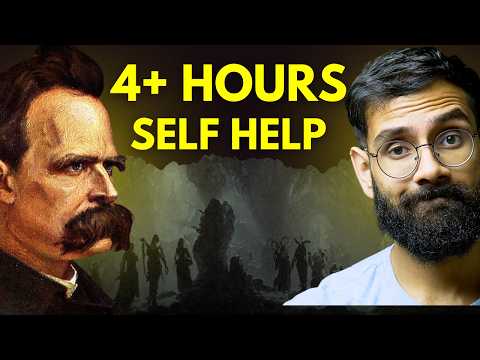
Friedrich Nietzsche's philosophy challenges conventional beliefs about free will, morality, and truth, advocating for a radical rethinking of values and the embrace of individual creativity. His works encourage readers to confront uncomfortable truths and cultivate a personal philosophy that transcends societal norms.
Friedrich Nietzsche is often hailed as one of the most controversial thinkers in history, known for his radical critiques of societal norms and cherished beliefs. In this blog post, we will delve into some of Nietzsche's most neglected works, including Human, All Too Human, Daybreak, and The Gay Science, to uncover what it truly means to be a free thinker in Nietzsche's eyes.
Nietzsche's concept of the free spirit is central to his philosophy. He challenges readers to question deeply held beliefs and societal orthodoxies, which he views as mere superstitions. The free spirit, according to Nietzsche, is someone who seeks to understand life without the comforting illusions that often cloud our judgment.
In Human, All Too Human, Nietzsche sets out to scrutinize the values that humanity holds dear through a scientific lens. He aims to strip away old ideas to allow free spirits to proceed without illusions. One of the key concepts he critiques is the notion of free will. Nietzsche argues that our choices are dictated by our character, which is shaped by inherited traits and environmental factors, thus denying the existence of unconditioned choice. This perspective leads to a hard determinism that challenges the very foundation of moral responsibility.
Nietzsche posits that the belief in free will is comforting because it gives us a sense of control over our lives. This illusion of control is essential for a fulfilling existence, as it allows individuals to feel responsible for their decisions. However, Nietzsche warns that this belief is ultimately a superstition that prevents us from recognizing the true nature of our existence governed by brute necessity.
Nietzsche's critique extends beyond free will to encompass metaphysics and religion. He argues that metaphysical claims, while potentially true, are ultimately pointless because they are beyond our comprehension. By discarding metaphysics, Nietzsche believes that free spirits can confront the harsh realities of life without the comforting narratives that often accompany them.
Nietzsche acknowledges that confronting these truths can lead to despair. He recognizes that many people find solace in metaphysical structures that provide meaning to their lives. However, he insists that the pursuit of truth must take precedence, even if it leads to uncomfortable realizations about the nature of existence.
In his later work, Ego Homo, Nietzsche emphasizes the importance of individuality. He argues that societal norms and public convictions can hinder the pursuit of truth. The free spirit must embark on a solitary journey to discover their own values, free from the influences of society.
Nietzsche's exploration of morality in Daybreak reveals his view that moral systems are often prejudices shaped by irrational drives. He believes that without questioning societal customs, individuals risk absorbing them uncritically, which compromises their ability to listen to their true feelings. This critique of morality is intertwined with his analysis of power dynamics within society.
Nietzsche's famous declaration that "God is dead" signifies a profound shift in the understanding of truth. He argues that the value of truth is not inherent but rather constructed by human perception. This leads to the unsettling conclusion that truth itself may not hold any intrinsic value, challenging the Enlightenment belief that truth is essential for human flourishing.
In Thus Spoke Zarathustra, Nietzsche introduces the idea of the Übermensch, or the overman, who transcends nihilism by creating new values. This creative spirit is essential for overcoming despair and forging a meaningful existence. Nietzsche encourages individuals to embrace their will and direct it towards self-creation, rather than relying on external authorities.
Nietzsche advocates for an experimental attitude towards life, where individuals try on different values and ideas to discover what resonates with them. This approach fosters a sense of lightness and humor, allowing individuals to appreciate the beauty in both the tragic and joyful aspects of existence.
Ultimately, Nietzsche's philosophy culminates in the concept of amor fati, or the love of fate. He challenges individuals to embrace their lives, with all its suffering and joy, and to desire that nothing should be different. This acceptance of life as it is represents true freedom and the ability to create meaning in a seemingly indifferent universe.
Friedrich Nietzsche's philosophy invites us to confront uncomfortable truths and to question the very foundations of our beliefs. By embracing the role of the free spirit, we can cultivate a personal philosophy that transcends societal norms and allows for the creation of new values. Nietzsche's call to become a dangerous thinker challenges us to explore the depths of our existence and to find beauty in the complexity of life.