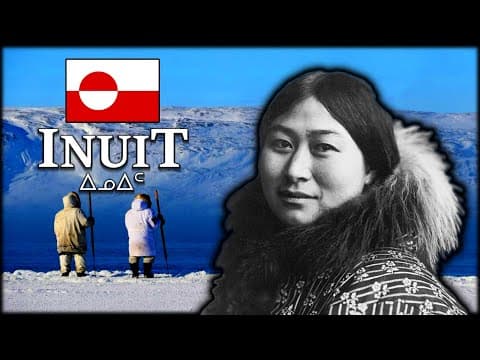
The Inuit, also known as Eskimos, have thrived in one of the harshest climates on Earth for thousands of years. This blog post delves into their unique history, culture, and adaptations that have allowed them to survive and maintain their identity despite external pressures and environmental challenges.
Imagine living in a small community of about 100 people, surrounded by breathtaking ocean views, yet enduring freezing temperatures year-round. This is the reality for the Inuit, also known as Eskimos, who have thrived in one of the harshest climates on Earth for thousands of years. With temperatures rarely rising above freezing and only a few hours of daylight in winter, their existence might seem remarkably uncomfortable. However, their lifestyle, culture, and resilience have captivated the interest of many, particularly in the Western world.
The Inuit people are part of the larger Eskimo-Aleut family, which includes other indigenous groups such as the Yupik and Aleutians. Their origins trace back to the last wave of migration across the Bering Strait from Northeast Asia. Genetic studies reveal that the Inuit share a significant genetic and linguistic affinity with other Northeast Asian peoples, such as the Chukchi and Koryaks. However, they also possess a large paleo-Amerindian genetic component, distinguishing them from Siberian populations.
In Canada and Greenland, the majority of the Inuit identify as Inuit, often specifying their smaller ethnic subgroup. In Alaska, the term Eskimo is used more loosely, encompassing the Inuit and related groups like the Yupik and Aleutians. Despite their close proximity, the languages spoken by these groups are not mutually intelligible, with significant dialectical differences.
Before the Inuit culture spread from Alaska to Greenland, the region was inhabited by the Dorset people, who eventually went extinct. Interestingly, the Norse arrived in Greenland before the Inuit, settling in the 11th century. The Inuit only migrated to Greenland in the 12th to 13th centuries, taking over territories previously occupied by the Dorset. Although there were rumors of intermixing between the Norse and Inuit, evidence suggests that this did not occur significantly.
When Europeans, primarily Danes, returned to Greenland centuries later, they encountered a largely intact Inuit society. Many Europeans integrated into Inuit communities, leading to a notable percentage of Inuit descendants in Greenland having European ancestry, particularly in the southwest corner of the island.
The arrival of Europeans had devastating effects on the Inuit population. Approximately 90% of the Inuit nation succumbed to diseases brought by Europeans, despite the vast distances between settlements. Unlike other indigenous groups, the Inuit homeland was not significantly encroached upon by settlers, allowing them to preserve their culture and way of life.
In Alaska, the Inuit were a minority among various indigenous peoples, including the Yupik and Aleutians, who had more contact with Russian missionaries and merchants. This interaction led to a significant percentage of Aleutians having partial Russian ancestry and practicing Orthodox Christianity.
The Inuit have adapted remarkably to their extreme environment. Their diet, heavily reliant on fish, seals, and other seafood, has led to genetic adaptations that allow them to consume large amounts of fat without adverse health effects. This adaptation is a result of thousands of years of living in the Arctic, making them some of the most resilient people in the world.
The Inuit homeland spans a vast area from Alaska to Greenland, covering nearly 1.9 million square miles. Despite this expansive territory, the population is only around 130,000, resulting in the lowest population density of any region on Earth, aside from Antarctica.
While many Inuit in Greenland speak their dialect as a first language, the number drops significantly in Canada and the United States. The Aleutian language, unfortunately, is nearing extinction. Traditional shamanistic beliefs have largely diminished, with most Inuit now practicing various forms of Christianity, influenced by European settlers.
The extreme climate and isolation of Arctic societies have led to significant mental health challenges, with Greenland having the highest suicide rate in the world. This has contributed to a notable emigration trend among Inuit populations, with many seeking opportunities in southern regions.
In Greenland, there is a growing movement for independence from Denmark, reflecting a complex relationship between the two. While there is no strong Inuit nationalism uniting all Inuit groups, the desire for self-determination is evident.
From their origins as scavenging nomads to their current status as resilient survivors, the Inuit, Yupik, and Aleutian peoples have a remarkable story of humanity's conquest over nature. Their culture has largely remained unchanged for thousands of years, standing in stark contrast to the rapidly evolving world around them. The Inuit's ability to adapt and thrive in one of the most extreme environments on Earth is a testament to their strength and resilience.
As we reflect on the Inuit and their heritage, it is essential to recognize their unique contributions to our understanding of human endurance and cultural preservation in the face of adversity.