This blog post delves into the history and cultural revival of the Kalinago people of Dominica, highlighting their resistance against colonization, their retreat into the mountains, and their ongoing efforts to reclaim and celebrate their identity in the 21st century.
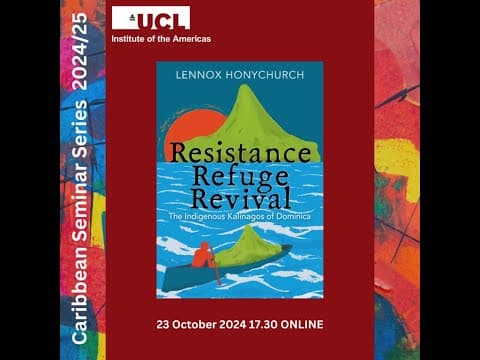
The Kalinago people, indigenous to Dominica, have a rich history marked by resistance, refuge, and revival. This blog post summarizes a seminar led by Lennox Honeychurch, a distinguished historian and anthropologist, who discussed his latest book, "Resistance, Refuge, Revival: The Indigenous Kalinago of Dominica." The seminar was part of the Caribbean Seminar Series at UCL Institute of the Americas, co-convened by Kate Quinn, Professor Gad Hum, and Dr. Steve Kushion.
Lennox Honeychurch is a prominent figure in the study of Dominica's history. Born in Portsmouth, he has contributed significantly to the understanding of the island's past through his numerous publications, including "The Dominica Story" and "The Fighting Maroons of Dominica." His work has been instrumental in educating scholars and students about the island's rich cultural heritage.
The seminar opened with an introduction by Kate Quinn, who highlighted Honeychurch's extensive knowledge and contributions to the field. Polly Pulo, the founder of Papot Press, also spoke about the importance of Honeychurch's latest book, which sheds light on the Kalinago people's history and their ongoing cultural revival.
Honeychurch structured his presentation around three key themes:
The history of the Kalinago people dates back thousands of years, with archaeological evidence suggesting human occupation of Dominica since around 5000 BC. The island was initially inhabited by hunter-gatherer groups who later evolved into agricultural societies. The arrival of the Arawaks and Caribs marked significant cultural shifts in the region.
The arrival of Christopher Columbus in 1493 marked the beginning of European interest in Dominica. Columbus named the island after the day of his arrival, and subsequent colonization efforts led to significant changes in the lives of the indigenous people. The Kalinago faced invasions and were often forced to retreat into the island's rugged interior.
The Kalinago people demonstrated remarkable resilience in the face of colonization. They strategically retreated into the mountainous regions of Dominica, where they could better defend themselves against European invaders. This period of resistance was characterized by fierce battles and negotiations with colonial powers.
In the early 20th century, under the governance of Henry Hesketh Bell, the Kalinago were granted a designated territory known as the Carib Reserve. This was a significant moment in their history, as it provided them with a space to preserve their culture and traditions amidst the pressures of colonization.
Today, the Kalinago people are actively engaged in cultural revival efforts. They are reclaiming their identity through various means, including education, tourism, and the arts. The establishment of the Kalinago Barana Aute cultural village serves as a focal point for these efforts, showcasing their heritage and traditions to both locals and visitors.
The Kalinago language and cultural practices are being revitalized, with increasing interest from both the Kalinago community and the wider Dominican population. The blending of Kalinago and African heritage is evident in the Creole language spoken in Dominica, which incorporates many Kalinago words.
The story of the Kalinago people is one of resilience, adaptation, and revival. Their journey from resistance against colonization to the contemporary revival of their culture is a testament to their enduring spirit. As they continue to navigate their identity in a modern context, the Kalinago people of Dominica serve as a powerful example of cultural survival and renewal in the face of historical challenges.