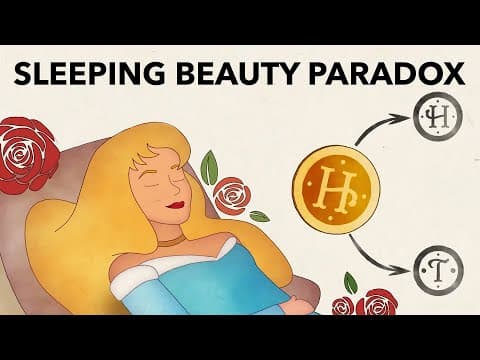
The Sleeping Beauty problem presents a controversial philosophical dilemma regarding probability assessment after a coin flip experiment. The debate centers around whether the probability of the coin landing heads is one-half or one-third, leading to two opposing views: the Halfer and the Thirder positions. This article explores the intricacies of the problem, its implications, and related thought experiments.
The Sleeping Beauty problem has sparked intense debate in the realms of mathematics and philosophy over the past two decades. This thought experiment challenges our understanding of probability and how we interpret information. In this article, we will dissect the problem, explore the differing perspectives, and consider related thought experiments that further complicate our understanding of probability.
The scenario begins with a character named Sleeping Beauty, who volunteers for an experiment. Before the experiment starts, she is informed of the procedure:
Each time she is awakened, she will forget that she was ever awake. During her brief moments of consciousness, she will not receive any new information but will be asked one crucial question: "What do you believe is the probability that the coin came up heads?"
Upon hearing the problem, many people's intuitive response is that the probability of the coin landing heads is one-third. This reasoning stems from the three possible scenarios:
However, this initial reaction raises questions about the nature of probability and the information available to Sleeping Beauty.
One perspective, known as the Halfer position, argues that the probability of the coin landing heads should be assessed as one-half. Proponents of this view assert that:
Thus, the Halfer position maintains that the probability remains unchanged regardless of the awakening process.
Conversely, the Thirder position posits that the probability of the coin landing heads is one-third. Advocates of this view argue:
This perspective emphasizes the importance of the context in which the question is asked and how the awakening alters her understanding of the situation.
The debate between the Halfer and Thirder positions has led to numerous philosophical papers and discussions. Each side presents compelling arguments, and the problem has inspired variations, such as scenarios where Sleeping Beauty is awakened multiple times if the coin lands tails.
To illustrate the complexity of probability assessments, the Monty Hall problem is often referenced. In this scenario, a contestant must choose between two doors, one hiding a prize. The contestant's odds are not simply 50/50, as the prize is more likely behind one door than the other. This analogy highlights that just because there are multiple outcomes does not mean they are equally likely.
The Sleeping Beauty problem leads to further thought experiments that challenge our understanding of probability:
The Simulation Argument: If we consider the possibility of living in a simulation, the argument suggests that if simulations can be created, it is likely we are in one. This parallels the Thirder position, where the existence of multiple outcomes influences our perception of reality.
The Soccer Game Scenario: Imagine a soccer game where a strong team (Brazil) faces a weaker team (Canada). If Brazil wins, you wake up once; if Canada wins, you wake up 30 times. The intuitive response would likely favor Brazil, despite the Thirder's reasoning.
The Sleeping Beauty problem serves as a fascinating exploration of probability, knowledge, and belief. It challenges our intuitions and forces us to confront the nuances of how we assess likelihoods based on available information. Whether one aligns with the Halfer or Thirder position, the discussion surrounding this problem continues to provoke thought and debate in philosophical and mathematical circles.
As we ponder these scenarios, we are reminded of the complexities of probability and the importance of context in our decision-making processes. The Sleeping Beauty problem is not just an academic exercise; it reflects deeper questions about knowledge, belief, and the nature of reality itself.