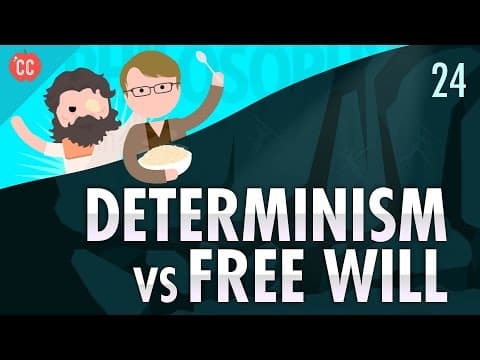
This blog post delves into the philosophical debate between determinism and libertarian free will, using the story of Oedipus as a backdrop to explore the implications of both views on human actions and personal responsibility.
Crash Course Philosophy presents a thought-provoking exploration of the concepts of determinism and free will, using the ancient Greek legend of Oedipus as a foundational narrative. This discussion raises essential questions about human agency, choice, and the nature of our actions.
To illustrate the complexities of fate and free will, the story of Oedipus is introduced. According to Greek legend, Oedipus was destined to kill his father and marry his mother, a prophecy that led his father to abandon him as a baby. Despite efforts to avoid this fate, Oedipus unknowingly fulfilled the prophecy, highlighting the philosophical notion that one cannot escape fate. This narrative serves as a springboard for discussing whether we are truly free in our choices or if our actions are predetermined.
The central question posed is whether we are genuinely free in our decisions. Many people feel a sense of freedom in their choices, believing that their actions stem from their own volition. This belief aligns with the concept of libertarian free will, which posits that individuals can act freely and make choices independent of prior causes.
Libertarian free will suggests that our decisions are not merely the result of preceding events. For instance, the choice to eat oatmeal for breakfast could be seen as a spontaneous decision, unbound by prior influences. However, this perspective faces challenges, particularly when considering the deterministic nature of the physical world, where every event is caused by something that came before.
In contrast, hard determinism asserts that every action is the inevitable result of preceding events. This view, championed by philosophers like Baron D’Holbach, argues that human actions are part of a larger causal chain, similar to physical events like a baseball being hit by a bat. According to hard determinism, our feelings of freedom are illusory; we are simply responding to a complex interplay of biological and environmental factors.
The tension between libertarian free will and hard determinism raises significant philosophical questions. Libertarians argue that free actions require the Principle of Alternate Possibilities, which states that an action is free only if the agent could have acted differently. However, hard determinists counter that if every event is caused, then true freedom cannot exist.
Libertarians often differentiate between event causation and agent causation. Event causation suggests that physical events are caused by prior events, while agent causation posits that individuals can initiate new causal chains through their decisions. This distinction attempts to reconcile the feeling of freedom with the deterministic nature of the universe. However, critics question the origins of these free decisions and whether they can exist independently of prior causes.
The discussion further explores how our beliefs, desires, and temperaments influence our decisions. For example, the choice of breakfast may seem free, but it is shaped by various factors, including personal preferences and situational constraints. Hard determinists argue that even seemingly random choices, like flipping a coin, are predetermined by prior influences.
The implications of hard determinism are profound. If our actions are predetermined, the concept of personal responsibility becomes problematic. As D’Holbach suggested, we are merely cogs in a machine, acting according to a predetermined script. This perspective challenges our understanding of morality and accountability, as it suggests that individuals do not possess true volition.
The exploration of libertarian free will and hard determinism reveals a complex philosophical landscape. While many of us feel a sense of freedom in our choices, the arguments for hard determinism present a compelling case for the absence of true free will. As we continue to grapple with these ideas, the search for a middle ground between determinism and libertarianism remains an open question, inviting further inquiry into the nature of human agency and existence.