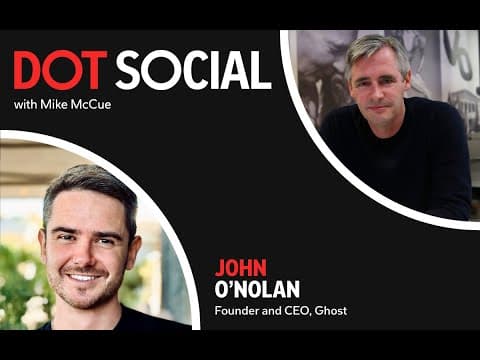
John O'Nolan, founder and CEO of Ghost, discusses the platform's shift towards federating with ActivityPub, aiming to enhance social interactions among publishers and readers while maintaining integrity in journalism. This move is seen as a pivotal moment for decentralized social media, promising improved content discovery and user engagement.
In a recent episode of the podcast "Doo," host Mike McHugh engages in a thought-provoking conversation with John O'Nolan, the founder and CEO of Ghost, an open-source publishing platform. The discussion centers around Ghost's recent announcement to federate over ActivityPub, a significant step towards enhancing social interactions in the decentralized social media landscape.
John O'Nolan begins by reflecting on Ghost's journey over the past decade as an independent publishing platform. He notes that while various competitors have emerged, they all share a common feature: a social interaction layer that allows publishers to connect with one another. O'Nolan emphasizes that many independent publishers often feel isolated, lacking a community to engage with their audience effectively.
In 2017, Ghost contemplated creating its own open API to facilitate decentralized news feeds but faced challenges due to its size. With the emergence of ActivityPub, O'Nolan and his team recognized an opportunity to explore this technology further. He describes the current moment as the right time to experiment with federating, given the growing interest from users and creators alike.
As Ghost prepares to integrate ActivityPub, O'Nolan shares insights from conversations with creators, including Casey Newton, who transitioned from Substack to Ghost. Many creators express a desire for better discovery capabilities, which have been a hallmark of platforms like Substack. O'Nolan acknowledges the tentative interest in ActivityPub but also highlights a collective exhaustion with traditional social networks and their algorithms.
He believes that ActivityPub can create a more organic web of discovery, allowing users to find content through connections rather than relying solely on structured recommendations. This organic discovery is crucial for fostering a vibrant community of publishers and readers.
O'Nolan envisions a future where Ghost can enhance content discovery through ActivityPub. He draws parallels to platforms like Twitter and Tumblr, where users discover new content through interactions with people they already follow. By integrating ActivityPub, Ghost aims to facilitate this kind of organic discovery, allowing users to stumble upon interesting content shared by their connections.
The conversation shifts to the challenges posed by traditional search engines and algorithms, particularly Google's recent algorithm leak, which revealed a bias towards larger sites. O'Nolan expresses concern that this trend has diminished the visibility of smaller, independent creators. He believes that ActivityPub can help restore a sense of community and connection, enabling users to discover content through trusted sources.
One of the key aspects of ActivityPub that O'Nolan emphasizes is its potential for two-way connections. Unlike RSS, which is a one-way broadcast, ActivityPub allows for interaction between publishers and readers. This two-way experience is vital for creating a sense of community and engagement within the platform.
O'Nolan outlines a vision where users can sign up for Ghost using either email addresses or ActivityPub handles, streamlining the onboarding process. This seamless integration aims to make it easy for users to engage with content and interact with publishers without the barriers typically associated with traditional platforms.
As Ghost continues to evolve, O'Nolan reflects on the platform's unique position in the decentralized web. He emphasizes the importance of open-source technology in fostering integrity in journalism. By providing a platform that prioritizes the needs of publishers, Ghost aims to level the playing field, allowing smaller newsrooms to compete with larger organizations.
O'Nolan's vision for Ghost extends beyond just publishing; he seeks to create a sustainable business model that aligns the interests of creators and their audiences. By enabling subscription models similar to those used by platforms like Substack, Ghost empowers publishers to build meaningful relationships with their readers.
The conversation concludes with O'Nolan expressing optimism about the future of decentralized publishing. He acknowledges the challenges ahead but believes that by fostering collaboration among creators, product builders, and users, the potential for a vibrant, interconnected web is within reach. As Ghost embarks on this journey with ActivityPub, the possibilities for enhancing content discovery and user engagement are exciting and transformative.
In summary, John O'Nolan's insights shed light on the future of decentralized publishing, emphasizing the importance of community, integrity, and innovation in creating a more connected and engaging online experience for publishers and readers alike.