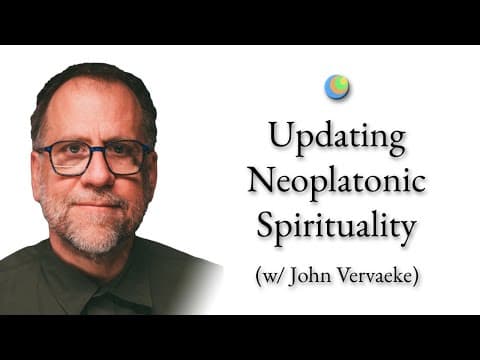
This article explores John Vervaeke's insights on updating Neoplatonic spirituality by integrating cognitive science, Zen Buddhism, and contemporary philosophy. It discusses the evolution of Neoplatonism beyond its ancient roots, the role of narrative in meaning-making, the balance between ascent and descent in spiritual practice, and the implications of embodiment, complexity, and non-duality in modern spiritual frameworks.
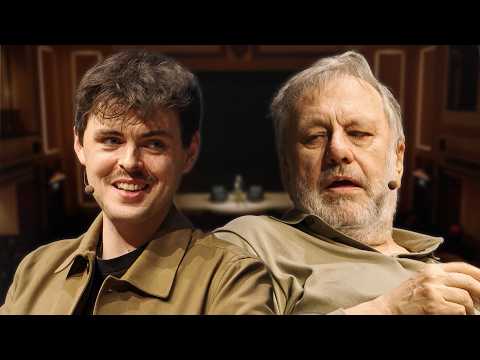
In a recent conversation with John Vervaeke, a professor of psychology at the University of Toronto and creator of the "Awakening from the Meaning Crisis" series, we delve into the fascinating intersection of Neoplatonism, cognitive science, and Zen Buddhism. Vervaeke, who describes himself as a Zen Neoplatonist, offers a compelling vision of how ancient spiritual traditions can be updated and revitalized to address the contemporary meaning crisis.
Neoplatonism, a philosophical and spiritual tradition rooted in the works of Plato and Plotinus, has long been a grand synthesis of Western wisdom traditions. However, Vervaeke emphasizes that the tradition must evolve to remain relevant in the scientific age. This involves:
He refers to this evolving tradition as "post-Neoplatonism," which requires new arguments and practices that reflect contemporary knowledge and pluralistic worldviews.
A significant update involves rethinking the ascetic tendencies in classical Neoplatonism. While Plotinus himself was ambivalent about the body, often expressing shame about embodiment, Vervaeke argues for the centrality of embodiment in spiritual practice. Zen Buddhism, with its rich aesthetic and Taoist dimensions, provides a counterbalance to the ascetic strain, emphasizing the importance of engaging fully with the world and the body.
Vervaeke discusses the Neoplatonic concept of the One, traditionally seen as the ultimate attractor or teleological aim. He proposes a nuanced view inspired by later Neoplatonists like Proclus and Nicholas of Cusa:
This conception aligns with modern physics' challenges in unifying quantum and cosmological scales and invites a philosophical openness to paradox and the coincidence of opposites.
The conversation highlights the importance of balancing the spiritual ascent (towards unity or the One) with the descent (engagement with particularity and the world). This dynamic tension, or tonos, is essential for a fulfilling spiritual life. Zen's emphasis on absolute differentiation complements Neoplatonism's focus on integration, creating a framework where both unity and multiplicity resonate.
Narrative remains a crucial component in addressing the meaning crisis. Vervaeke acknowledges that while reality itself may not be a narrative in the mythological sense, narrative structures are indispensable for:
However, he cautions against anthropomorphizing reality or imposing mythological narratives that attribute agency and teleology to the universe itself. Instead, narrative is a transjective and imaginal practice that supports human meaning-making without conflating it with objective reality.
A profound question arises regarding non-duality, which dissolves the distinction between entity and field, and how meaningfulness can persist in such a framework. Vervaeke explains that:
Zen and Neoplatonism together offer a path to navigate this paradox, emphasizing that the realization of non-duality is not the final point but part of an ongoing dynamic polarity.
The discussion touches on traditional Christian Neoplatonic views of the afterlife, such as the resurrection of the body, which is understood as a profound ontological event affirming embodiment rather than a simplistic escape to a heavenly realm. This contrasts with classical Buddhist notions of samsara and nirvana, where the cycle of rebirth is itself affirmed as part of the spiritual path.
Vervaeke critiques simplistic two-worlds mythologies and highlights the importance of integrating these perspectives to affirm life fully, including its finitude and mortality.
John Vervaeke's approach to metamodern spirituality offers a rich, integrative framework that updates Neoplatonic spirituality by incorporating cognitive science, Zen Buddhism, and contemporary philosophical insights. It challenges us to rethink embodiment, narrative, complexity, and non-duality in ways that are deeply relevant to the modern meaning crisis. This evolving tradition invites a dynamic balance between ascent and descent, unity and particularity, and ultimately, a profound engagement with the world and ourselves.
This conversation opens many avenues for further exploration and dialogue, promising a vibrant future for spiritual philosophy in the 21st century.