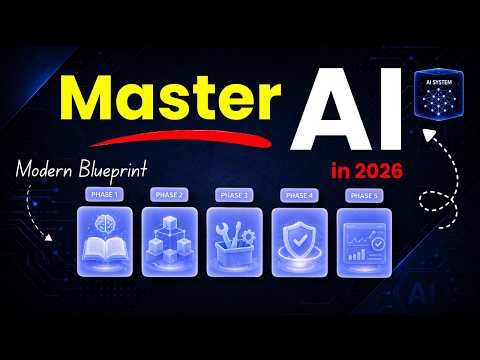
This comprehensive guide outlines a practical 5-phase blueprint to master AI in 2026, focusing on the shift to agentic AI, essential foundational skills, modern tools, AI governance, and building a proof-of-skill portfolio. It emphasizes learning to orchestrate intelligence, using agents and multi-agent systems, understanding light math, mastering Python and Mojo, ensuring AI safety and compliance, and creating impactful projects to prove your expertise.
If you are excited about AI but feel overwhelmed about where to start, or if you have begun learning AI but find the knowledge quickly becoming outdated, this guide is for you. The AI landscape in 2026 has dramatically shifted from previous years, and following outdated roadmaps may prepare you for a world that no longer exists. This article presents a practical, no-fluff, structured 5-phase blueprint to take you from beginner to a skilled AI practitioner capable of building, deploying, and monetizing real AI systems in today's market.
Grab a coffee and get comfortable as we dive into the essential phases.
The biggest change in AI for 2026 is the shift from focusing on building machine learning models to orchestrating intelligence. Instead of just answering questions, AI systems now execute complex workflows, make decisions, use tools, and work collaboratively as teams of agents. Think of AI not as a smart friend answering questions but as a workforce of specialists handling tasks autonomously.
This shift from "talkers" to "workers" is crucial. Planning AI systems requires structured thinking, often visualized through mind maps or workflow diagrams to connect research, analysis, decision-making, and output clearly. This clarity makes execution easier and more effective.
Vibe coding means coding by intent. Instead of writing every line of code, you describe what you want in natural language, and AI helps build it. This is system-level communication, where you define an AI agent's role, tools, boundaries, and decision-making process—more like writing a job description for a capable employee than a simple prompt.
The era of basic prompt engineering is fading; now, sophisticated structured instructions are key. Learning how to chain instructions, handle context, and communicate precisely with AI models is essential.
You don't need deep mathematical expertise but should understand key concepts to make informed decisions:
Python remains the dominant AI programming language, powering major frameworks like LangChain, Hugging Face, and FastAPI. Learning Python is the highest ROI investment.
Mojo is an emerging high-performance language designed for AI infrastructure, offering speed advantages for running large models and multi-agent systems. While not mandatory now, awareness of Mojo is beneficial.
Asynchronous programming in Python, especially with FastAPI, is critical for handling real-time AI agents performing multiple tasks simultaneously.
Simple chatbots are outdated. Modern AI systems are agents that use tools to accomplish goals autonomously. For example, an agent can research competitors, extract pricing, and update a Google Sheet automatically.
Key frameworks include LangGraph (workflow as graphs), CrewAI (multi-agent collaboration), and Microsoft AutoGen (conversational multi-agent workflows).
Multiple specialized agents work together like a human team, each with specific roles (research, writing, quality checking, output formatting). This coordination solves complex problems efficiently.
Learning how agents communicate, assign roles, handle conflicts, and orchestrate workflows is essential.
AI models don't remember past interactions by default. RAG combined with vector databases (like Pinecone and Weaviate) stores information semantically, enabling agents to recall and connect relevant knowledge across sessions.
Implementing RAG pipelines transforms agents from demos to useful products.
Unlike traditional ML Ops, LM Ops focuses on monitoring and maintaining large language model-based agents, which can fail subtly (e.g., hallucinations, circular reasoning).
Tools like LangSmith and Phoenix provide traceability into agent decisions, essential for debugging and trust.
Fine-tuning general models to specialize in domains is done efficiently with LoRA (low-rank adaptation) and QLoRA (quantized LoRA), enabling training on consumer-grade GPUs.
This specialization is highly valuable for businesses needing domain-specific AI expertise.
Hallucinations and bias are major risks. Guardrails (e.g., Nvidia's Nemo) enforce rules on what AI can say or do, intercepting unsafe outputs.
Auditing for bias and applying debiasing techniques is critical to avoid systemic harm.
Agents with tool access face threats like prompt injection, where malicious instructions hidden in inputs can hijack agent behavior.
Defenses include strict input separation, least privilege access, output validation, and human-in-the-loop checkpoints.
Regulations like the EU AI Act classify AI systems by risk and impose documentation, testing, and transparency requirements.
Understanding compliance is mandatory for building auditable, explainable, and legally sound AI systems.
Degrees matter less than demonstrable skills. A portfolio proving your ability to orchestrate AI intelligence into action is key.
Build agents interacting with the physical world, such as smart home automation, stock trading bots, or manufacturing monitoring systems using accessible hardware and APIs.
Specialize a general AI model for a specific domain (medical coding, legal research, agriculture, finance) using fine-tuning and RAG to create highly useful expert agents.
Develop a system managing multiple specialized agents with dashboards showing status, tasks, and errors, integrating orchestration, vector databases, monitoring, and frontend visualization.
This advanced project showcases comprehensive mastery.
The modern AI practitioner is an engineer and builder who can analyze real-world problems, design appropriate architectures, select models and tools, ensure safety and compliance, and execute solutions effectively.
This 5-phase blueprint guides you through:
The biggest barrier is starting. The best time to begin was 18 months ago; the second best is now. Pick one step from this blueprint and take consistent action. Whether installing Python, building your first agent, or implementing RAG, progress comes from doing.
Share this roadmap with others feeling lost in AI. The map exists, and with dedication, you can master AI in 2026 and beyond.
Start your journey today and transform from a learner to a trusted AI builder.