In this detailed account of a Kerbal Space Program mission, we explore the challenges and triumphs of docking two space stations in orbit. From rocket launches and orbit adjustments to docking maneuvers and safe landings, this mission showcases the complexity and excitement of space exploration in the game, culminating in a historic docking and safe return of all crew members.
Welcome back to the Jaden Space Agency (JSA) mission logs! After a successful first episode where we launched a rocket into orbit and built a space plane capable of takeoff and landing without crashes, we are now embarking on a more challenging mission: docking two satellites in orbit. This mission is a crucial step before we can consider going to the moon.
Our agency has grown phenomenally, with a multi-billion dollar valuation. The Markiplier Mark II program was a success, reaching orbit and landing with fuel to spare. However, the previous docking attempt failed due to improper decouplers and fuel crossfeed issues. To fix this, we added proper docking ports and ensured no fuel crossfeed between stages.
We also added solar panels to prevent power loss and equipped the ships with sufficient RCS (Reaction Control System) and monopropellant for maneuvering during rendezvous and docking.
We launched two Markiplier Mark III rockets aiming for an orbit altitude of 80,000 meters. The launches went smoothly, with careful adjustments to maintain the correct orbit. We fought against the natural tendencies of the rockets to veer off course and managed to stabilize the orbits at the desired altitude.
Understanding orbital mechanics was key. We adjusted the apoapsis and periapsis by burning retrograde at the correct points in the orbit. Thanks to the JSA community's advice, we learned to retrograde at the periapsis to lower the apoapsis and vice versa.
We aligned the orbits of both spacecraft to prepare for rendezvous. This involved adjusting the orbital planes and altitudes to bring the two ships close enough for docking.
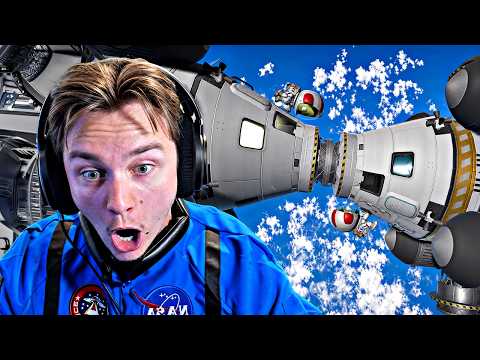
As the two spacecraft approached each other, we carefully managed their relative velocities, aiming to close the distance gradually. Despite running out of monopropellant at a critical moment, we managed to dock the two ships successfully by carefully aligning the docking ports and using the ships' momentum.
This was a historic moment for the JSA — the first successful docking of two ships in orbit without RCS thrust.
After docking, crew members Valentina and Jebidiah performed EVAs (Extra-Vehicular Activities) to inspect and celebrate the successful docking. The combined spacecraft formed the JSA Space Station (JSS), a significant milestone for our space program.
With the mission complete, we prepared for de-orbiting. The combined spacecraft began a retrograde burn to lower its orbit and re-enter the atmosphere. We encountered some challenges with spinning and center of mass issues but managed to stabilize the descent.
We performed a final docking maneuver during descent and then decoupled the modules for landing. Despite some confusion and last-minute adjustments, all crew members landed safely, marking a successful mission completion.
This mission was more challenging than the previous ones, but it demonstrated the JSA's growing capabilities. We launched two rockets, docked them in orbit, and landed safely with all Kerbals alive.
Looking ahead, the next big goal might be a mission to the moon. But for now, we celebrate this historic docking and the teamwork that made it possible.
The Jaden Space Agency has proven that with careful planning, community support, and a bit of luck, complex space maneuvers like docking two space stations in orbit are achievable. This mission sets the stage for even more ambitious explorations in the future.
Thank you for following along with the JSA's journey. Stay tuned for more space adventures!