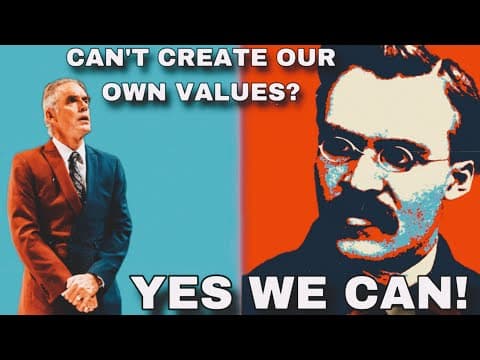
This blog post critically examines Jordan Peterson's interpretation of Friedrich Nietzsche's philosophy, particularly regarding the creation of values and the concept of the Overman. It argues that Peterson fundamentally misunderstands Nietzsche's ideas, conflating moral values with a broader conception of values and misrepresenting the implications of Nietzsche's philosophy for individual and societal development.
In this blog post, we will explore the critical response to Jordan Peterson's interpretation of Friedrich Nietzsche's philosophy, particularly focusing on the concept of values and the Overman. This analysis will highlight the key misunderstandings and misrepresentations that arise in Peterson's readings of Nietzsche, ultimately arguing that his interpretations fail to grasp the depth and complexity of Nietzsche's thought.
The structure of this discussion will differ from typical analyses, as it serves as a response to Jordan Peterson's claims regarding Nietzsche's philosophy. Specifically, we will examine Peterson's interpretation of Nietzsche's project of values creation, as articulated in his 2016 personality lecture. This post will include a detailed reading of Nietzsche's own words to provide clarity and context, followed by a critique of Peterson's assertions.
In his lecture, Peterson discusses Nietzsche's idea of the Overman (often translated as Superman) and the necessity for individuals to create their own systems of meaning and morality. He posits that this process of values creation is fraught with challenges, including the potential for conflict when individuals develop incompatible value systems. Peterson argues that without a shared moral framework, society risks descending into chaos.
Peterson states:
"N talked about the development of the being he called the Overman... people would have to take onto themselves the burden of creating new systems of meaning and new moralities that were suited to them."
He raises concerns about the feasibility of individuals creating their own values, suggesting that:
"If you come up with your sister system of values and I come up with mine, there's no reason to assume that they're going to be sufficiently integratable."
Peterson further argues that individuals struggle to adhere to their own values, citing the difficulty of self-discipline and the presence of conflicting drives within the self.
One of the primary issues with Peterson's interpretation is that he conflates moral values with a broader conception of values as understood by Nietzsche. For Peterson, values appear synonymous with moral principles that individuals consciously adopt. In contrast, Nietzsche's conception of values encompasses a wider range of evaluations that are not limited to morality.
Nietzsche asserts:
"Hitherto moral values have been the highest values... if we bring down the values from their pedestal, we thereby alter all values."
This indicates that Nietzsche believed values could be restructured and ranked differently, suggesting that moral values are not the only form of value.
Peterson's interpretation implies that the creation of values is a novel task that arose only after the death of God. However, Nietzsche argues that humanity has always created its own values throughout history. The Overman is not merely a future ideal but represents a new value that humanity must strive towards.
Nietzsche writes:
"Every Thou shalt was once an I will... values do not refer to eternal truths; they had to develop over a long course of time."
This perspective emphasizes that values are contingent and evolve based on the needs and conditions of life, rather than being static moral imperatives.
Peterson raises several problems regarding Nietzsche's project of values creation:
Peterson often ties the concept of the Overman to the creation of values, suggesting that the Overman will emerge as a new moral authority. However, Nietzsche's vision of the Overman is not about individual achievement but rather about the evolution of humanity itself. The Overman symbolizes a new value system that transcends traditional moral frameworks.
Nietzsche states:
"I teach you the Overman; mankind is something to be overcome."
This indicates that the Overman is not a figure to be emulated in the present but a goal for humanity to strive towards collectively.
In summary, Jordan Peterson's interpretation of Nietzsche's philosophy, particularly regarding the creation of values and the Overman, reveals significant misunderstandings. Nietzsche's project is not about individual moral relativism but rather about the evolution of values in response to life's demands. The Overman represents a new value system that challenges existing moral frameworks, rather than a call for each individual to create their own values from scratch.
Ultimately, Peterson's approach appears to reflect a desire to cling to traditional values in the face of existential uncertainty, while Nietzsche's philosophy encourages a dynamic reevaluation of values that fosters growth and transformation. Understanding these distinctions is crucial for engaging with Nietzsche's thought in a meaningful way.