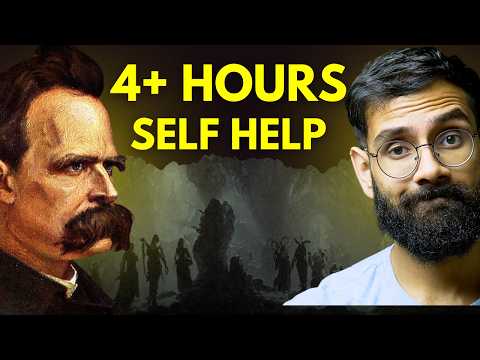
Friedrich Nietzsche argues that arguing often stems from weakness, driven by ego and the need for validation. True strength lies in self-mastery, authenticity, and the ability to engage in meaningful dialogue rather than petty disputes. By focusing on self-overcoming and understanding, individuals can transform conflicts into opportunities for growth.
Imagine a world where debates dominate every conversation, where winning an argument seems like the pinnacle of intelligence. But is arguing truly a sign of strength, or could it be a mask for something deeper—perhaps even weakness? Today, we explore the profound ideas of Friedrich Nietzsche, one of history's most provocative thinkers, to unravel why arguing, in his eyes, is often the refuge of the weak.
Nietzsche challenges many societal norms, and his view on arguing is no exception. He believed that strength lies not in dominating a conversation or winning a debate but in the courage to stand firm in one's convictions—even in silence. For Nietzsche, those who constantly argue often compensate for a lack of inner clarity or self-assuredness.
To understand Nietzsche's perspective, we must first consider why we argue. Is it to prove a point, assert dominance, or defend our sense of self? Nietzsche would argue that at the heart of most disputes lies a fragile ego—a need to validate oneself through the submission or agreement of others. This need for external validation is a hallmark of weakness. Strong individuals, on the other hand, are content with their truths, unshaken by dissent.
In his masterpiece Thus Spoke Zarathustra, Nietzsche introduces the concept of the Overman (or Übermensch), a figure who transcends societal norms and lives authentically. The Overman does not engage in trivial disputes because their focus is on self-overcoming, not on proving themselves to others. Nietzsche believed that those who constantly argue are stuck in a state of ressentiment, defining themselves in opposition to others rather than through their own values.
Consider the last argument you had. Was it truly about the topic at hand, or was there a deeper emotional undercurrent? Perhaps a need to be seen as intelligent or worthy? Nietzsche would say that the strongest individuals recognize this impulse and resist it. Instead of reacting, they reflect. Instead of arguing, they rise above.
Nietzsche did not advocate for passivity or silence in the face of injustice. Quite the opposite—he valued action over words. For him, strength was demonstrated through life choices and values, not through empty rhetoric. The truly powerful do not need to convince others of their beliefs; they embody them. Arguing rarely changes minds; it only entrenches positions.
In today's world, social media amplifies every disagreement, turning minor differences into full-blown conflicts. Nietzsche's perspective invites us to ask: What am I trying to achieve here? Is this argument worth my energy, or am I simply reacting to the expectations of others? His philosophy challenges us to step back and focus on building our inner strength instead of tearing others down.
For Nietzsche, building inner strength begins with self-knowledge. Most people are not fully aware of their motives, fears, and desires. Without this awareness, we become slaves to external forces, easily provoked and manipulated. Inner strength, on the other hand, comes from a deep understanding of oneself, allowing individuals to remain grounded regardless of external chaos.
Nietzsche's critique of arguing extends to the concept of truth. He believed that absolute truth is an illusion, a construct created by humans to make sense of the world. If truth is subjective, then what's the point of arguing over it? Nietzsche encouraged individuals to explore their values, beliefs, and purpose rather than conforming to societal norms or seeking validation through arguments.
How can we engage with others without falling into the trap of argumentation? Nietzsche suggests that the answer lies in the art of dialogue. Unlike arguments, which are adversarial and aimed at winning, dialogues are collaborative and aimed at understanding. In a dialogue, both parties approach the conversation with humility and a willingness to learn.
Conflict, when approached constructively, can be a powerful catalyst for growth. Nietzsche challenges us to rise above petty disputes and focus on what truly matters: the pursuit of excellence, authenticity, and a life lived on our terms. This requires a shift in mindset from seeing others as adversaries to seeing them as fellow travelers on the journey of life.
Nietzsche's concept of eternal recurrence asks us to imagine living our lives over and over again, with every moment repeating infinitely. This thought experiment forces us to confront the choices we make and the values we uphold. Would you want to spend eternity locked in trivial arguments, or would you rather devote your life to something more meaningful?
Nietzsche famously declared, "There are no facts, only interpretations." This perspective invites us to embrace the complexity of truth and recognize that multiple perspectives can coexist. Instead of seeing disagreements as threats to our worldview, we can view them as opportunities to expand our understanding.
Nietzsche's philosophy is about embracing the challenges and uncertainties of existence with courage and creativity. Life is not a problem to be solved but a canvas on which to create meaning. Arguing, in this context, is a distraction from the real work of life—the work of becoming who we are meant to be.
Nietzsche believed that silence could be a form of strength—a refusal to be drawn into the pettiness of argumentation. This silence is not one of submission but of self-assuredness. It reflects someone who knows their worth and does not need to prove it.
As we conclude our exploration of Nietzsche's philosophy, we are left with a profound insight: strength is not about overpowering others but about mastering oneself. True strength lies in the courage to live authentically, the humility to question our assumptions, and the wisdom to focus on what truly matters.
The next time you feel the urge to argue, pause and reflect. Ask yourself what you are trying to achieve and what this moment reveals about your own insecurities or desires. Nietzsche's philosophy invites us to choose the path of strength, wisdom, and self-overcoming, even when it is the harder path. In the end, the greatest argument we can ever make is not with words but with the lives we choose to live.