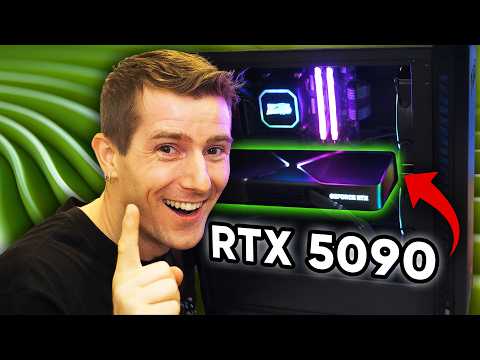
NVIDIA's recent keynote introduced the RTX 5090 and the entire 50 series lineup, showcasing significant advancements in GPU technology, including DLSS 4.0 and AI-assisted features, while also hinting at future developments in robotics and machine vision.
The recent NVIDIA keynote was a spectacle of innovation, with CEO Jensen Huang making a memorable remark about the RTX 4090 being one of the best investments for entertainment. However, he also acknowledged that NVIDIA's stock price at the time of the RTX 4090's launch was around $11.50, suggesting that investing in NVIDIA stock might have been a more lucrative choice. For those who missed the boat, the RTX 5090 is now on the horizon, promising to deliver cutting-edge performance at a premium price.
The event kicked off with a stunning real-time rendered demo, setting the stage for the introduction of the new RTX Blackwell 50 series GPUs. These GPUs come equipped with groundbreaking technologies such as DLSS 4.0, DLSS Transformer, and neural faces. One of the standout claims made by Jensen was that the RTX 5070 would deliver performance levels comparable to the RTX 4090 at a price of $549. However, he cautioned that achieving this performance would rely heavily on AI technology.
Behind the scenes, attendees were given the first hands-on experience with the RTX 5090. The GPU features a compact PCB design with advanced power delivery, allowing for a dual-fan, dual-slot cooler that enhances airflow. This design eliminates the need for cumbersome right-angle adapters, improving cable management.
The RTX 5090 is positioned as a significant upgrade over the RTX 4090. While specific performance metrics are under embargo, initial impressions suggest that the 5090 will outperform its predecessor in various gaming scenarios. The GPU is expected to handle demanding titles like Cyberpunk 2077 with ease, thanks to its enhanced specifications, including a 512-bit memory bus and an increase in CUDA cores.
During the demo, the RTX 4090 was tested with the latest build of Cyberpunk, showcasing NVIDIA's new transformer model and DLSS 4 frame generation. The performance was impressive, but the RTX 5090 is anticipated to take gaming visuals to the next level. Jensen highlighted that in his demo, only a fraction of the pixels were calculated directly, with the majority being extrapolated using AI, raising questions about the realism of the visuals.
While DLSS 4.0 promises lower latency and fewer artifacts compared to its predecessor, some issues were noted, such as text blurring and ghosting on high-contrast objects. Despite these minor drawbacks, the overall visual fidelity was remarkable, and the technology is expected to improve further with future updates.
Beyond the RTX 5090, NVIDIA introduced the entire 50 series lineup, including the RTX 5070 and RTX 5080. The 5070 is set to offer impressive performance at a lower price point, while the 5080 is positioned as a flagship product at $999, down from the previous generation's pricing. This pricing strategy reflects NVIDIA's response to market competition and aims to provide better value to consumers.
NVIDIA also announced the 50 series for laptops, starting at $1299 for the RTX 5070, claiming it can deliver RTX 4090 performance while consuming half the power. This move indicates NVIDIA's commitment to enhancing mobile gaming experiences.
In addition to GPU advancements, Jensen introduced the NV72 AI racks, which boast incredible processing power and efficiency. These innovations are expected to revolutionize robotics and machine vision, with partnerships aimed at applying AI training to real-world applications.
Another significant announcement was the Cosmos project, designed to create a foundation model for robots to understand and interact with the physical world. This initiative aims to reduce the risks and costs associated with training humanoid robots in real environments.
The NVIDIA keynote was packed with exciting announcements and innovations that promise to reshape the landscape of gaming and technology. With the RTX 5090 leading the charge, NVIDIA is poised to maintain its position at the forefront of the graphics industry. As we await the official performance metrics and consumer reactions, one thing is clear: the future of gaming and AI technology is bright, and NVIDIA is at the helm of this transformation.