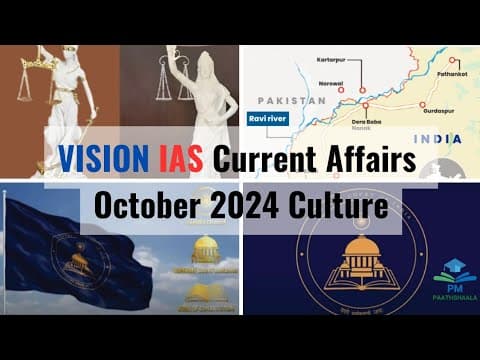
This blog post covers the key cultural current affairs from October 2024, including the recognition of classical languages in India, the significance of the Kartarpur Sahib Corridor, and the introduction of Lady Justice in the Supreme Court, along with notable awards and initiatives in the cultural sector.
In this blog post, we will explore the significant cultural current affairs from October 2024, as highlighted in the Vision IAS monthly magazine. The focus will be on the recognition of classical languages in India, the importance of the Kartarpur Sahib Corridor, and the introduction of Lady Justice in the Supreme Court. We will also touch upon notable awards and initiatives that have emerged in the cultural sector.
Recently, the Union Cabinet of India granted classical language status to four languages: Marathi, Pali, Prakrit, and Bengali. This decision is crucial for the preservation and promotion of these languages, which are integral to India's cultural heritage.
A classical language is defined as an ancient language that has a rich cultural and historical significance. The criteria for a language to be classified as classical include:
The concept of classical languages was first introduced by the Indian government in 2004, with Tamil, Sanskrit, Telugu, Kannada, and Malayalam being the initial languages recognized. With the recent additions, the total number of classical languages in India has now reached eleven.
The recognition of a language as classical comes with several benefits:
The Kartarpur Sahib Corridor, which facilitates visa-free travel for Indian pilgrims to the Gurudwara in Pakistan, has had its agreement extended for another five years. This corridor is significant for the Sikh community as it connects them to the final resting place of Guru Nanak Dev Ji.
The corridor not only promotes religious tourism but also fosters people-to-people connections between India and Pakistan. It serves as a symbol of peace and cultural diplomacy, allowing pilgrims to visit the sacred site without the need for a visa.
In a recent initiative, the Supreme Court of India unveiled a new statue of Lady Justice, symbolizing the judiciary's commitment to impartiality and justice. This statue replaces colonial symbols with representations that resonate with Indian traditions.
Lady Justice has its origins in Greek and Roman mythology, representing fairness and equality. The new statue features an open eye, symbolizing that justice is not blind and sees all equally, along with the Indian Constitution as a representation of legal supremacy.
The Nobel Prize in Literature for 2024 was awarded to South Korean author Han Kang for her intense poetry that explores historical trauma and the fragility of human life. This recognition highlights the global impact of literature in addressing profound human experiences.
The Indian government approved the development of the National Maritime Heritage Complex at Lothal, Gujarat. This initiative aims to showcase India's rich maritime heritage and promote tourism through various projects, including a world-class lighthouse museum.
Eight traditional products from Assam received the Geographical Indication (GI) tag, recognizing their unique cultural significance and promoting local craftsmanship.
The cultural current affairs of October 2024 reflect India's commitment to preserving its linguistic heritage, promoting religious tourism, and enhancing the significance of justice in society. These developments not only enrich the cultural landscape but also foster a sense of unity and identity among the diverse communities in India.