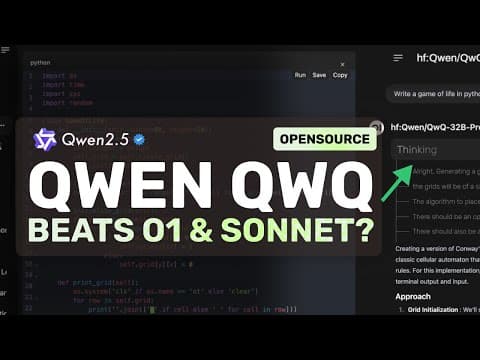
Qwen QwQ-32B: A New Open Source AI Model That Competes with O1 and Sonnet
The Qwen QwQ-32B is a new open-source AI reasoning model that shows promising capabilities but has limitations. It can be run locally and competes with existing models like O1 and Sonnet, particularly in coding tasks. Despite some shortcomings in reasoning and safety, it offers a glimpse into the future of open-source AI development.
In a recent announcement, Qwen has introduced a new AI model named QwQ-32B, coinciding with the Thanksgiving holiday. This model is designed to enhance reasoning capabilities, similar to the O1 model, but is developed by Qwen. It is a 32 billion parameter model, akin to their previous coder model, and can potentially be run locally on high-performance GPUs, such as the NVIDIA 4090.
Overview of Qwen QwQ-32B
The QwQ-32B model is described as an experimental research model that aims to advance AI reasoning capabilities. While it shows promising analytical abilities, it also has several limitations that users should be aware of:
- Language Mixing and Code Switching: The model may unexpectedly mix languages or switch between them, which can affect the clarity of responses.
- Circular Reasoning Patterns: It may enter loops of reasoning that lead to lengthy responses without providing a conclusive answer.
- Safety and Benchmark Issues: Due to its new architecture, there are some safety concerns and benchmark performance issues.
Despite these limitations, the QwQ-32B model has demonstrated competitive performance in certain benchmarks, outperforming O1 in AIM and Math 500 tests, although it did not surpass O1 in GPQ and Live Code Bench.
Accessing the Model
The Qwen team has made the QwQ-32B model open weight, allowing users to access a demo version. It is also available on the API Marketplace (AMA), enabling users to run it locally. This accessibility is a significant advantage for developers and researchers interested in experimenting with the model.
Testing the QwQ-32B Model
To evaluate the QwQ-32B model, a series of 13 questions were posed to it, testing its reasoning and coding capabilities. Here are some highlights from the testing process:
- Country Name Question: The model was asked to identify a country whose name ends with "Leah" and provide its capital. The response was incorrect, indicating issues with its training dataset.
- Rhyme Question: When asked for a number that rhymes with a tall plant, the model correctly identified "three" as the answer.
- Logic Puzzle: In a scenario involving five people in a house, the model correctly stated that it could not determine what person C was doing, showcasing its ability to recognize incomplete information.
- Mathematical Problem: The model successfully solved a problem regarding the number of people in a scenario, demonstrating its mathematical reasoning skills.
- Coding Tasks: The model was tasked with generating HTML and Python code. It successfully created a functional HTML page with a button that explodes confetti and a Python program to print leap years based on user input.