Peter Singer argues that charitable giving should be viewed as a moral obligation rather than an optional act of kindness. He critiques consumerism and planned obsolescence, urging a shift in societal attitudes towards helping others and addressing the root causes of poverty.
In the realm of ethics, few discussions are as provocative as Peter Singer's arguments regarding charitable giving and moral responsibility. Singer challenges the conventional belief that charity is merely supererogatory—good to do but not wrong not to do. Instead, he posits that helping others is not just commendable but obligatory. This blog post delves into Singer's conclusions, critiques of consumerism, and the implications of his moral philosophy.
Singer begins by addressing the common perception that charitable acts are optional. Most people view charitable giving as a commendable act, but they do not consider it a moral requirement. This attitude leads to a lack of guilt or shame when individuals choose to spend money on luxuries instead of helping those in need. Singer argues that this perspective is fundamentally flawed.
He asserts that failing to assist others when one has the means to do so is morally wrong. In his view, charity should be seen as a moral obligation akin to saving a drowning child. Just as one would be condemned for not saving a child in peril, so too should individuals be held accountable for not contributing to charitable causes when they are able.
To align societal attitudes with this moral obligation, Singer suggests that we need to rethink our social norms surrounding charity. He believes that uncharitable behavior should be frowned upon, although he acknowledges the importance of approaching this change with sensitivity to avoid defensiveness.
Moreover, he argues that individuals should feel guilt or shame for indulging in luxuries when those resources could be used to save lives. This shift in perspective is crucial for fostering a culture that prioritizes altruism over consumerism.
Singer's critique extends beyond individual attitudes to encompass the broader societal obsession with consumerism. He highlights the phenomenon of planned obsolescence, where companies design products to become outdated quickly, compelling consumers to purchase replacements frequently. This practice not only wastes resources but also diverts funds that could be used for charitable purposes.
For instance, instead of creating durable products, companies often prioritize short-term profits by ensuring that their goods become obsolete within a few years. Singer argues that this cycle of consumption detracts from our ability to contribute to meaningful causes and ultimately harms society.
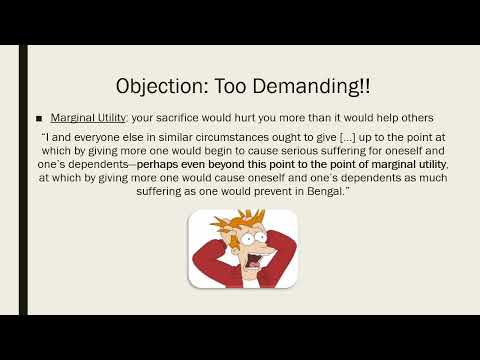
One of the most contentious aspects of Singer's argument is the strong Singer principle, which suggests that individuals should give until they reach the point of marginal utility. This point is defined as the threshold at which further giving would cause more harm to oneself than it would benefit others. Critics often view this stance as excessively demanding, suggesting that it requires individuals to make significant sacrifices for the sake of others.
Singer acknowledges this concern but counters that if individuals are not sacrificing anything of moral importance, then the demands of his principle are not as extreme as they may seem. He also proposes a more strategic approach to giving, suggesting that individuals could invest in their education and careers to enable them to donate more effectively over time.
Singer emphasizes that charitable giving is not solely about alleviating immediate suffering but also about addressing the root causes of poverty. He encourages individuals to consider broader issues such as overpopulation and the exploitation of resources in poorer nations. By focusing on systemic problems rather than just symptoms, individuals can contribute to more sustainable solutions.
Additionally, Singer highlights the importance of political advocacy and promoting human rights as essential components of addressing global poverty. He argues that efforts to prevent humanitarian disasters, such as asteroid impacts, also fall within the realm of moral obligations, as they aim to minimize suffering on a global scale.
In response to objections regarding the demanding nature of his principles, Singer introduces the is-ought fallacy. Critics may argue that because most people do not adhere to his moral standards, those standards should be reconsidered. However, Singer counters that the prevalence of self-interest does not negate the validity of moral obligations. Just as a doctor would advise healthy living regardless of people's willingness to follow that advice, moral imperatives remain valid irrespective of societal behavior.
Singer's arguments compel us to reevaluate our moral frameworks and the societal norms surrounding charitable giving. By recognizing charity as a moral obligation rather than an optional act, we can foster a culture that prioritizes altruism and addresses the pressing issues of poverty and consumerism. Ultimately, the challenge lies in shifting our perspectives and actions to align with the moral imperatives that Singer advocates, ensuring that our resources are directed towards making a meaningful impact in the world.