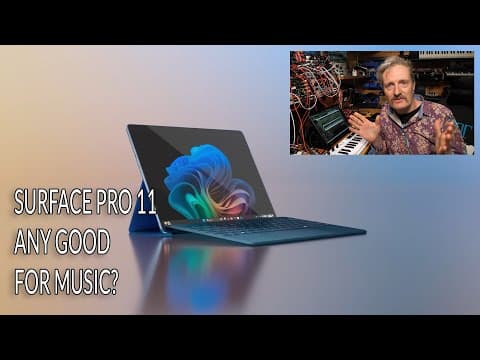
The Surface Pro 11 shows promise for music production with its new ARM architecture and powerful Snapdragon processors, but challenges remain regarding software compatibility and audio driver support. While it may work for some users, its effectiveness for music production is still uncertain until further testing and software updates are available.
Hello, I'm Robin, and welcome to the Surface Pro Audio wing of Molton Music Technology. Over the years, I've tested every single Surface Pro device since the Surface Pro 3. It's a fabulous device that I love for its touchscreen, pen interaction, sleek design, and mobility. It has become a vital component in my music studio, allowing me to run virtual instruments and effects processing seamlessly.
Recently, I've received numerous inquiries about the new Surface Pro 11 and its suitability for music production. While I haven't had direct experience with the Surface Pro 11 yet, I want to discuss its potential based on the information available and feedback from users.
Microsoft has made a significant shift from traditional Intel and AMD processors to ARM processors, specifically the Snapdragon X and Snapdragon X Elite. This change is exciting as it promises enhanced processing power in a compact form factor. However, it also raises concerns about software compatibility.
To run Windows on ARM, software must be recompiled and optimized for the new architecture. Currently, there are no known audio software or plugins that run natively on ARM processors. This situation may change in the future, but for now, it poses a challenge for music producers.
Regular software compiled for Intel should run on Windows ARM through an emulation layer. While this allows for installation and operation, performance may not be optimal. The emulation process can introduce latency issues, which are critical for music production.
One of the most significant hurdles for the Surface Pro 11 is the audio driver architecture. Unlike software, audio drivers cannot be emulated. They need to be specifically designed for Windows ARM to ensure low-latency performance. Currently, there are no manufacturers providing Windows ARM drivers for audio interfaces, which could severely impact music production capabilities.
In previous experiences with the Surface Pro X, I found that using software like ASIO4ALL could help manage audio routing and latency issues. ASIO4ALL allows users to combine audio systems and access multiple inputs and outputs, which could be beneficial for Surface Pro 11 users facing driver limitations.
While I await the opportunity to test the Surface Pro 11 myself, feedback from users has been mixed. Some have reported success with audio recording using ASIO4ALL, but others have encountered significant latency issues when using WASAPI drivers. The performance of virtual instruments and real-time monitoring is crucial for music production, and any noticeable lag can hinder creativity.
The Surface Pro 11 is equipped with AI capabilities and promises a powerful user experience. However, until software developers optimize their products for ARM architecture, the device's full potential for music production remains uncertain. The upcoming release of MIDI 2.0 may also influence its usability, as Windows on ARM is expected to support this new standard natively.
In summary, the Surface Pro 11 appears to be a promising platform for music production, but significant challenges remain. While it offers advanced processing capabilities, the lack of native software and audio driver support could limit its effectiveness. If you're considering purchasing a Surface Pro 11 for music production, proceed with caution and stay tuned for further developments in software compatibility and driver support.
In the meantime, I will continue to explore and test the Surface Pro 11 as more information becomes available. If anyone has a Surface Pro 11 they'd like to send my way for testing, I'd be more than happy to dive deeper into its capabilities. Until then, keep making music!