This blog post explores Nietzsche's philosophy on the power of silence, emphasizing that true strength lies not in constant verbal expression but in the mastery of silence. It discusses how silence can be a strategic tool in communication, allowing individuals to maintain control and authority in conversations, and highlights the psychological implications of speaking versus remaining silent.
Imagine being in a heated discussion where your heart races and your mind is filled with arguments ready to be unleashed. The instinct to respond and defend oneself is strong, but what if the moment you feel that desperate need to react is the moment you have already lost? This is the essence of Nietzsche's philosophy on silence and strength.
In our modern world, strength is often equated with the ability to argue, to impose oneself, and to have a sharp response ready at all times. However, Nietzsche viewed this perspective differently. He believed that true power does not lie in shouting louder or forcefully convincing others; rather, it lies in what you choose not to say.
We are surrounded by noise—social media, endless debates, and people competing to have the last word. Yet, in this cacophony, those who truly possess power are often the ones who observe and wait. When they finally choose to speak, their words carry weight, much like a stone thrown into a calm lake.
Nature teaches us that the urgency to speak and justify oneself reveals a subtle type of weakness. Those who desperately seek to be heard are often seeking validation. They react, and in doing so, they allow themselves to be controlled. In contrast, those who master silence possess a different kind of authority—one that does not require proving anything to anyone.
Consider the individuals who have made a lasting impact on you. Were they the ones who spoke incessantly, or were they those whose few words struck you profoundly? Well-used silence generates mystery, respect, and discomfort, prompting others to think deeply.
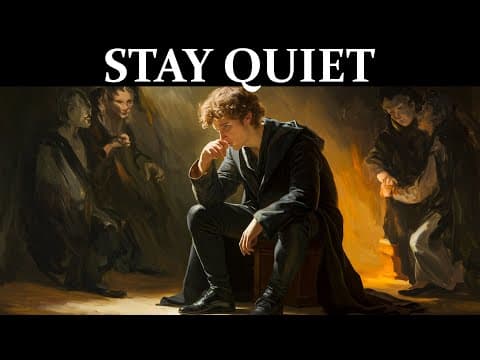
The question arises: do you have control over your words, or are you a slave to the need to be heard? Silence is not merely a choice; it is a challenge that few have the strength to face. In a world filled with noise, silence forces introspection, which can be uncomfortable for those who have built their identities on external validation.
Nietzsche introduced the concept of the Ubermensch, or "Superman," which is not about physical strength or status but about absolute mastery over oneself. The Ubermensch does not react impulsively or seek acceptance; instead, they create their own values and rules. One of their main weapons is silence.
When you remain silent in situations where a response is expected, you generate discomfort and reverse the power dynamic. Your silence forces others to confront their own anxieties and insecurities. The average person is terrified of emptiness and often fills silence with unnecessary words, but the Ubermensch understands that silence can be more powerful than any argument.
True leaders do not need to raise their voices or justify their actions. Their presence alone commands respect. In contrast, those who constantly talk and seek to convince others often reveal their insecurities. Nietzsche recognized that the one who talks too much is being controlled by their emotions, while the one who remains calm and silent is in control.
Silence acts as a psychological weapon. It disarms and confuses, compelling others to reveal themselves without you needing to say a word. When someone expects a response and receives silence instead, their mind enters a state of uncertainty, leading them to question their own position.
To apply Nietzsche's philosophy, one must learn to observe before responding. Most people react impulsively, but those who master silence wait, analyze, and then decide if a response is warranted. Not every conversation deserves your attention; many are merely ego-driven battles.
When you do choose to speak, ensure your words carry weight. By speaking less frequently, your words will be more impactful, making others listen. It is not about the quantity of words but the quality and impact of what you say.
Ultimately, the question remains: do you control your silence, or does your silence control you? Nietzsche viewed life as a game of forces, where the weak talk excessively to justify themselves, while the strong understand that the absence of words can carry more weight than a thousand speeches.
When you are silent, you reveal your true essence, forcing the world to see you without distractions. This can be unsettling for many, as most people build their identities based on external reactions. However, those who master the art of silence become unshakable, no longer needing to explain themselves or seek validation.
Reflect on your own experiences: when was the last time you remained silent when expected to speak? What impact did that have on those around you? Embracing silence can be a powerful tool for self-mastery and influence, allowing you to navigate the complexities of communication with strength and authority.