The Easter Bunny, often claimed to have pagan origins, is actually a modern invention rooted in 17th-century German traditions. The earliest reference to an Easter Bunny comes from a 1682 treatise, and the association with pagan deities is largely speculative and unfounded.
Every Spring, a familiar claim circulates online: the Easter Bunny is an ancient symbol with deep roots in Pagan mythology and religious practice. This assertion is not limited to social media; it can also be found in reputable sources. For instance, a PhD holder writing for Smithsonian Magazine suggests that the Easter Bunny recalls pre-Christian celebrations of Spring, while the BBC mentions an Anglo-Saxon deity named Aost, who was accompanied by a rabbit representing Springtime's rejuvenation and fertility. However, these claims do not hold up under scrutiny.
The real history of the Easter Bunny is far more modern than these articles suggest. The earliest known reference to anything resembling an Easter Bunny comes from a 1682 treatise by a German physician named Georg Frank von Franconau. He mentions an Easter egg hunting tradition involving a hare in regions of the Holy Roman Empire, specifically what is now Western Germany and Eastern France. Franconau writes that children believed a hare, referred to as the Easter hare, laid eggs hidden in gardens.
It is important to note that Franconau referred to an Easter hare, not a bunny. Scientifically speaking, hares and rabbits are different animals, although both belong to the order Lagomorpha. The tradition of Easter eggs, however, predates the Easter hare. Eggs have been linked to Easter since the medieval period, as Christian sources like the Council of Trullo in 692 CE mandated abstaining from animal products, including eggs, during Lent. Eggs became a common food to break the fast after Lent.
Franconau's mention of the Easter hare marks the earliest concrete evidence of this local folk tradition among Protestant German-speaking populations in 1682. It was these same groups who carried the tradition across the Atlantic. In the early 1700s, German-speaking Anabaptists from regions like the Palatinate and Alsace immigrated to Pennsylvania, forming the community known as the Pennsylvania Dutch. This group included both the Amish and the Mennonites, who brought various folk customs, including the Easter hare.
The earliest evidence of this in America comes from paintings by Pennsylvania Dutch folk artist Johan Conrad Gilbert, who moved to Pennsylvania in 1757. His drawings depict an Easter hare carrying a basket filled with painted eggs. Over time, the Easter hare became the Easter Bunny, as the German word "Hase" (hare) was commonly translated to "rabbit" in English, primarily because rabbits were more common in Pennsylvania than hares.
By the late 1800s, contemporary observers linked the growing popularity of the Easter hare in America to recent German immigration. An 1890 article in The Atlantic referred to the Easter hare as a quirky novelty that had only recently become familiar in American culture. This suggests that the Easter hare was distinctly German in origin and not part of a broader European tradition.
Despite the clear historical origins of the Easter Bunny, some theories attempt to link it to ancient pagan traditions. One popular theory suggests a connection to a springtime goddess named Aost. However, the only direct reference to a goddess named Aost comes from the Venerable Bede, an English monk writing in 725 CE. Bede mentions a month in the old English calendar called Aost month, named after a goddess in whose honor feasts were celebrated. Beyond this single passage, there are no other ancient sources, myths, or archaeological evidence for her worship.
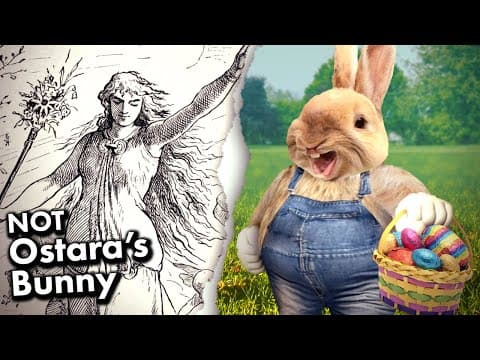
The connection between Aost and the Easter Bunny is largely linguistic. Jacob Grimm, a German linguist and folklorist, theorized in 1835 that Aost had a German counterpart named Ostara, based solely on the etymology of the Old High German word for Easter, "ostan." However, no direct evidence exists for Ostara, and Grimm's argument was purely speculative.
In 1874, German scholar Adolf Holzmann made the first known connection between Ostara and the Easter hare, suggesting that the hare was a sacred animal of Ostara. This connection was based on the assumption that if the English had a goddess named Aost, the Germanic peoples must have had their own version. However, this is a tenuous link at best.
As the Easter Bunny tradition gained popularity, various fanciful explanations emerged. In 1883, a German writer speculated that the Easter hare must have originally been a bird transformed by the goddess Ostara, retaining its egg-laying abilities. This narrative was amplified in later decades, leading to increasingly imaginative tales about the Easter Bunny's origins.
While rabbits and hares have been notable symbols in various cultures, the specific tradition of the Easter Bunny as we know it today is a modern invention. The association of rabbits with springtime likely stems from their natural behaviors rather than any direct connection to ancient religious practices. Folklorist Steven Winnick argues that rabbits and hares are indexically linked to spring because they are particularly active during this season.
In different parts of Germany, the role of Easter egg deliverer has been assigned to various animals, suggesting that the choice of animal was flexible and not inherently tied to rabbits. Thus, rather than searching for ancient bunny-themed mythology, it is more accurate to view the Easter Bunny as a general folk tradition where any small familiar animal could take on the role of delivering Easter eggs.
In conclusion, the Easter Bunny is not a relic of ancient paganism but rather a modern tradition that has evolved over time, shaped by cultural exchanges and local customs. As we celebrate Easter, it is essential to recognize the true origins of this beloved symbol and appreciate its journey through history.