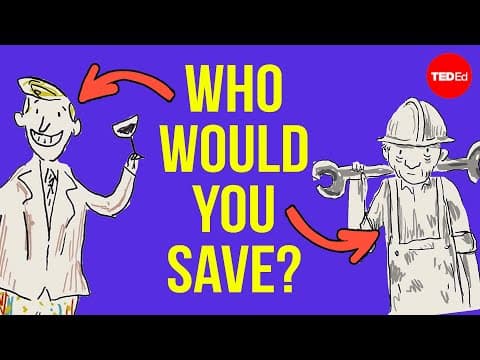
In a scenario where a captain must choose between saving a group of disadvantaged workers or privileged students, various ethical frameworks such as utilitarianism, prioritizing the worse off, and equal concern are explored to navigate the complexities of life-and-death decisions.
You are the captain of the Mallory 7, an interstellar cargo transport. On your way to the New Lindley spaceport, you receive a distress call. There’s been an explosion on the Telic 12, and its passengers are running out of oxygen. As you set a course to intercept, you check the Telic 12’s manifest. It’s currently transporting 30 middle-aged individuals from some of Earth’s poorest districts to the labor center on New Lindley, where they'll be assigned jobs on the spaceport.
However, as you approach the Telic 12, you receive a second distress call. A luxury space cruiser called the Pareto has lost a thruster, sending them careening towards an asteroid belt. Without your help, the 20 college students headed for vacation aboard the Pareto are all doomed. With only enough time to save one ship, which one should you choose?
This scenario presents a classic ethical dilemma, illustrating a broader class of problems where a life-saving resource—such as a donated organ or vaccine—is scarce. The decision of whom to save raises significant moral questions and invites various philosophical perspectives.
One of the most influential ethical frameworks is utilitarianism, systematically developed by philosophers Jeremy Bentham and John Stuart Mill. According to this view, one should choose the action that promises the greatest sum of happiness. In this case, saving 30 lives on the Telic 12 seems to generate more happiness than saving 20 lives on the Pareto.
However, defining and measuring happiness is complex. Hedonists might argue that a happy life is one filled with pleasure and devoid of pain, while others might contend that happiness comes from fulfilling desires. Regardless of the definition, many would agree that saving more lives generally leads to greater happiness.
Yet, the question arises: is it enough to consider how many lives would be saved? Should we also factor in how many life years would be saved? Assuming a life expectancy of 80 years, saving the lives of the students, who average 20 years old, would save 1,200 life years. In contrast, saving the workers, who average 45 years old, would save 1,050 life years. This suggests that saving the younger students might promise a greater sum of happiness due to their longer potential life span.
If the cold calculations of utilitarianism feel unsatisfactory, other philosophical approaches offer different insights.
Philosopher Derek Parfit argues that we should give priority to the worse off, as benefits to disadvantaged groups matter more than equivalent benefits to the well-off. In this scenario, the workers on the Telic 12 are among the most disadvantaged, traveling away from home for months to perform service work. Conversely, the students aboard the Pareto are likely among the wealthiest individuals, able to afford a luxury vacation.
This raises the question: should we prioritize the workers who have faced more hardship in their lives, or consider the students who have experienced less life overall? Determining which group is truly worse off can quickly become complicated, especially in a world marked by drastic inequalities in wealth and opportunity.
John Taurek, another philosopher, famously argued that in such cases, the numbers don’t count. He suggests that each person deserves equal concern and respect, proposing that the best way to decide whom to save is to flip a coin. While this approach may seem arbitrary, it treats all individuals equally, giving each an equal chance of being rescued.
Could any passenger argue that they are being treated unfairly by a coin flip? The answer is uncertain, but the emotional responses to the outcome may present another layer of complexity in this moral quandary.
The dilemma of whom to save in a life-and-death situation encapsulates the complexities of ethical decision-making. Whether through the lens of utilitarianism, prioritizing the worse off, or advocating for equal concern, each perspective offers valuable insights into the moral implications of our choices. Ultimately, this thought experiment challenges us to reflect on our values and the principles that guide our decisions in critical moments.