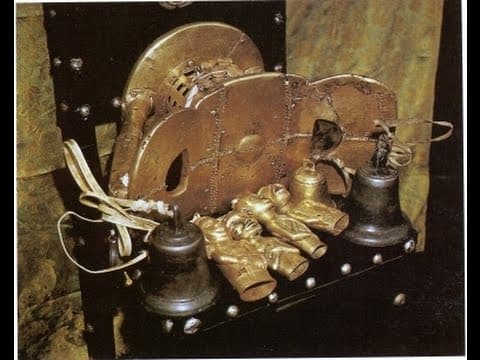
The Golden Stool, a sacred symbol of the Asante people, represents their unity, culture, and resistance against colonial powers. Originating in the early 1700s, it embodies the essence of the Asante nation and has played a crucial role in their history, particularly during conflicts with British colonial forces.
In the heart of the University of Pennsylvania Museum of Archeology and Anthropology, the Golden Stool, a significant cultural artifact of the Asante people, is discussed. Although the stool itself is not part of the museum's collection, its importance resonates through various objects that symbolize the rich history and culture of the Asante nation in Ghana.
The story of the Golden Stool begins in the early 1700s with Osei Tutu, a pivotal king who unified the surrounding lands to form the Asante nation. According to legend, the Golden Stool fell from the sky and landed in Osei Tutu's lap, marking it as a miraculous object. This wooden stool, covered in gold, is considered the soul of the Asante nation, embodying the essence of the entire group. Its significance surpasses that of any individual king, as it is revered as more sacred than the Asantehene, the king himself.
The Asante region is rich in gold, which symbolizes royalty and power. Historically, the Asante people controlled the gold trade in North Africa long before European involvement. Gold is not only a material wealth but also a color associated with royalty, evident in textiles and artifacts reserved for royal use.
In the museum, various brass weights used for measuring gold are displayed. These weights are intricately designed, depicting scenes from daily life and significant figures, including the Asante king. The umbrella, a recurring symbol in these weights, signifies the presence of the king, who is often depicted with sandals, emphasizing his divine status as an intermediary between the people and the supernatural.
The Asante people have a unique way of communicating through art and proverbs. Each brass weight carries messages that can be decoded by those familiar with the cultural language. For instance, a weight depicting two crocodiles sharing one stomach symbolizes familial bonds and the importance of community support. Another weight shows a ram, representing thoughtful contemplation before taking action.
The British interest in the Asante region, particularly in the 19th century, was driven by the desire to control gold resources. This led to the naming of the area as the Gold Coast. The Asante people resisted British encroachment, leading to significant conflicts. In 1874, the British destroyed the Asante capital and sought to seize the Golden Stool, which they viewed as a symbol of power.
In response to British demands for the Golden Stool, Yaa Asantewaa, a queen mother, rallied soldiers to defend their sacred object. Although the Asante were ultimately defeated, the Golden Stool remained hidden, preserving its sanctity. The British governor's demand for the stool to sit upon was met with outrage, as it was a profound insult to the Asante people.
Despite the defeat, the Asante people retained some autonomy, and by the 1920s, the British allowed the return of Prempeh I, the Asantehene. A promise was made that the Golden Stool would not be taken, allowing it to emerge from hiding. The stool is not only a royal symbol but also a significant part of everyday life for the Asante people, who receive stools from their parents upon reaching adulthood.
In Asante culture, stools are imbued with personal energy, known as soon soon. This concept suggests that the objects we use regularly become part of our essence. To protect this energy, individuals traditionally tip over their stools when leaving a room, signaling that it is not intended for anyone else. The Golden Stool, too, is often kept turned on its side, symbolizing its sacred status.
The Golden Stool is more than just an artifact; it is a profound symbol of the Asante nation's identity, unity, and resilience. Its history reflects the struggles against colonialism and the enduring cultural values of the Asante people. As the soul of the Asante nation, the Golden Stool continues to hold a revered place in the hearts of the Asante, embodying their spirit and heritage.