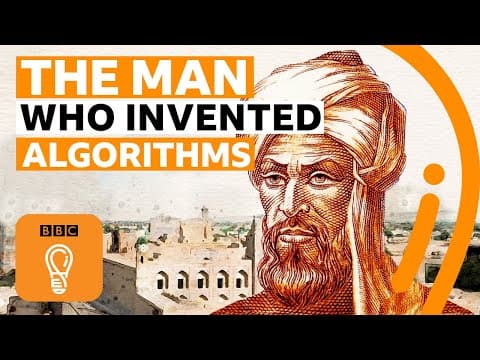
The term 'algorithm' has a rich history dating back to the 9th century, originating from the Persian mathematician Al-Khwarizmi. His contributions to mathematics laid the groundwork for modern algorithms, which are now integral to technology, influencing everything from internet searches to personal recommendations.
Algorithms are often perceived as a modern invention, but their roots stretch back nearly a millennium. The term 'algorithm' is derived from the name of a remarkable Persian mathematician, Muhammad ibn Musa al-Khwarizmi, who was born around 780 AD in what is now Uzbekistan. His legacy has profoundly influenced mathematics and technology as we know it today.
Al-Khwarizmi served as the director of the House of Wisdom, an intellectual hub for scholars in 9th Century Baghdad. His work spanned various fields, including mathematics, astronomy, geography, and cartography. One of his most significant contributions was his book titled Concerning the Hindu Art of Reckoning. This work was pivotal in introducing Hindu-Arabic numerals to the Western world, which eventually replaced the cumbersome Roman numeral system.
The Hindu-Arabic number system, along with the concept of the decimal point, was described in detail by Al-Khwarizmi in his writings. These innovations form the foundation of the numerical system used globally today. The Latinized version of his name, 'algoritmi', gave rise to the term 'algorithm'. Additionally, Al-Khwarizmi is credited with the term 'algebra', stemming from another of his influential works.
In medieval Latin, the term 'algorismus' referred specifically to the decimal number system. By the 13th Century, this term had made its way into the English language, appearing in the works of writers such as Geoffrey Chaucer. However, it wasn't until the late 19th Century that 'algorithm' evolved to signify a set of step-by-step rules for solving problems.
The early 20th Century marked a significant turning point in the understanding of algorithms, thanks to the British mathematician and computer scientist Alan Turing. Turing theorized how machines could follow algorithmic instructions to solve complex mathematical problems, laying the groundwork for the computer age. During World War II, he developed a machine known as the Bombe, which utilized algorithms to decipher the Enigma code, showcasing the practical applications of algorithms in real-world scenarios.
Today, the term 'algorithm' is ubiquitous, even if its precise function is not always understood. Algorithms play a crucial role in various aspects of our daily lives, including:
The journey of the word 'algorithm' from medieval Persia to its current significance in technology illustrates how a simple concept can evolve and transform our lives in profound ways.
In conclusion, the legacy of Al-Khwarizmi continues to shape our world, reminding us of the deep historical roots of the technologies we often take for granted today. Algorithms are not just mathematical constructs; they are integral to the fabric of modern society, influencing countless decisions and interactions in our daily lives.