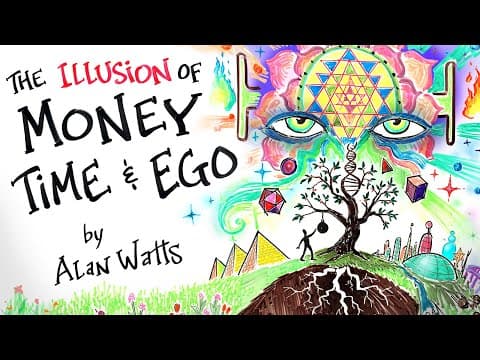
Alan Watts explores the illusions surrounding money, time, and ego, urging us to embrace real silence and experience reality as it is, rather than through the lens of societal constructs and expectations.
In a thought-provoking discussion, Alan Watts invites us to pause and reflect before making decisions that could impact our planet. He emphasizes the importance of experiencing reality without the interference of constant thought and societal constructs. This article delves into his insights on the illusions of money, time, and ego, encouraging a deeper understanding of our existence.
Watts begins by suggesting that before we decide to save or destroy the planet, we should take a moment of real silence. This silence is not the somber kind observed in mourning but a genuine stillness where we can experience reality as it is. He argues that constant thinking and self-talk prevent us from engaging with the real world.
Watts challenges the notion that reality can be fully understood through concepts or words. He posits that both material and spiritual interpretations of the world are merely constructs. The real world exists beyond ideas and language, and by connecting with it, we can dispel many illusions.
One of the primary illusions Watts addresses is that of money. He describes money as a useful tool for accounting and measuring wealth, akin to inches for length or grams for weight. However, he points out that money itself is not wealth; it cannot be consumed or enjoyed.
Watts illustrates this by stating that one cannot eat money or live in multiple houses simultaneously. The obsession with accumulating money often leads to a disconnection from what truly matters—food, companionship, and experiences. He emphasizes that money should be viewed as a representation of wealth, not the wealth itself.
Another significant illusion is the concept of the ego. Watts explains that many people confuse their identity with their personality or the labels society places on them. This limited view of oneself can lead to unhappiness and fear, particularly the fear of death.
Watts recounts a conversation with a woman who feared death, revealing that her anxiety stemmed from concern about how others would perceive her. This highlights how our self-concept is often shaped by external opinions rather than our true selves.
Watts also tackles the pervasive illusion of time. He notes that many people claim they have no time, which reflects a lack of awareness of the present moment. He argues that the present is the only real time, and our fixation on the past and future detracts from our ability to live fully.
He critiques the common perception of the present as a mere point between the past and future. Instead, he suggests that the present is where creation occurs. By constantly blaming the past for our current circumstances, we fail to recognize our role in shaping our reality.
Alan Watts' insights challenge us to reconsider our relationship with money, time, and ego. By embracing real silence and engaging with reality, we can begin to see through the illusions that cloud our understanding. Ultimately, Watts encourages us to live in the present, recognizing that we are the creators of our own experiences, free from the constraints of societal expectations and fears.