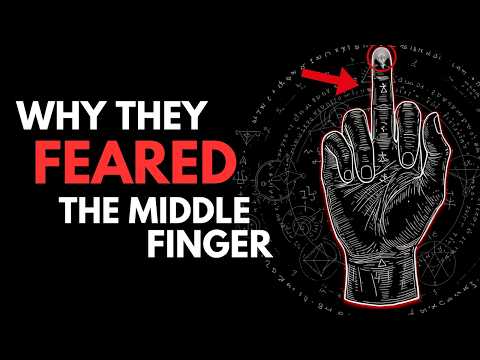
The middle finger, often seen as a symbol of anger and rebellion, has a rich history rooted in ancient philosophies where it represented the element of ether, a connection to the unseen forces of the universe. This blog explores how its meaning transformed over time, reflecting societal shifts in power and perception.
What if one of the most offensive symbols in our culture was never meant to be offensive at all? What if it started as a secret so powerful that over time it had to be buried, twisted, and turned into a joke just to keep people from ever asking what it really meant? Today, we’re talking about the middle finger.
The middle finger is universally recognized as a gesture of anger, rebellion, and vulgarity. However, beneath its crude reputation lies a hidden story—a story few people know. Long before modern society reduced it to an insult, the middle finger represented something sacred in ancient systems, including Hindu philosophy, Greek teachings, and early spiritual traditions.
In these ancient traditions, the middle finger was linked directly to the element of ether, the invisible force that binds the universe together. Ether was considered the fifth element, representing the realm of vibration, space, and pure potential. It was believed to be the bridge between the physical and the spiritual, a medium through which energy flows, where thoughts shape reality, and where manifestation begins.
The human body, seen as a reflection of the cosmos, carried that elemental power in each finger:
This wasn’t random; the middle finger, reaching tallest and aligned with the body’s central axis, represented expansion, transcendence, and connection to something greater. Through it, ether flowed—the essence of potential.
What happens when knowledge about our connection to energy and creation falls into the wrong hands? It gets demonized. The middle finger’s role as a conduit for ether became a forgotten footnote in philosophy and spiritual texts. Slowly, its sacred symbolism slipped from memory, leaving only the gesture stripped of context, ready to be redefined by subsequent cultures.
In ancient Greece, philosophers and playwrights still remembered fragments of the middle finger's original meaning, yet it began taking on crude undertones. Aristophanes, known for his biting comedies, used the gesture to mock and humiliate, reflecting a culture shifting away from ether's reverence towards something easier to control. The Romans followed suit, calling it the "digitus impudicus" or the shameless finger, using it both to insult and to ward off evil.
As Christianity spread through Europe, symbols associated with fertility, natural forces, or spiritual independence became targets. Gestures that once represented cosmic connections were rebranded as vulgar or sinful. The middle finger's rise as an offensive gesture mirrors this wider pattern: strip the meaning, label it shameful, and teach generations to fear or laugh at it.
While the world forgot the middle finger's origins, science began to circle back to the very ideas ancient traditions revered. By the 19th century, physicists theorized the existence of luminiferous ether, a medium filling the cosmos through which light and energy traveled. Although this specific theory was later abandoned, modern physics replaced it with concepts like dark matter and dark energy—scientific terms for forces we can't see but know are there.
The connection between ether, consciousness, and reality isn’t confined to ancient philosophy; it runs through modern science. The observer effect in quantum physics reveals that particles behave differently when measured, indicating that reality responds to attention. This aligns perfectly with the ancient understanding of ether as the unseen medium of potential.
According to yogic and energy medicine systems, the body is designed to interact with this field. Breath, thought, and movement channel energy. Specific hand gestures, known as mudras, focus that flow. Among these, the middle finger carries a unique role, governing ether—the element of space and expansion linked to the throat chakra, where expression and vibration emerge.
Practitioners of Shunya mudra or Akasha mudra use the middle finger to consciously engage ether's qualities. These gestures serve as energetic switches, aligning the mind, body, and environment. In this context, manifestation isn’t about wishful thinking; it is the focused direction of energy using intention, breath, and movement to shape possibilities.
The middle finger, far from being meaningless or obscene, stands as a physical conduit for this process. Its height, position, and symbolic link to ether make it the natural channel for engaging the unseen forces that govern creation. The same finger that gestures defiance once signified power over the forces shaping the material world.
Across history and science, the middle finger's role as a bridge between intention and reality lingers. Whether through sacred mudras or subconscious gestures, it carries an ancient whisper: the human mind and body are not separate from the forces that shape the universe. The deeper truth is that the human body carries these connections everywhere through movement, sound, and intention.
The middle finger's journey from sacred symbol to vulgar gesture reflects how power changes hands and how knowledge capable of connecting us to something greater gets buried beneath mockery and shame. What began as a physical reminder of ether—the unseen force linking mind, body, and universe—was reduced to a crude signal of anger stripped of context. Yet, its energy never disappeared; it lingered in the subconscious, in the defiant lift of a hand, in the instinct to push back against control.
Reclaiming symbols like the middle finger means reclaiming the parts of ourselves designed to interact with the unseen. Everyday gestures, words, and beliefs may hide more than they reveal. Some were never meant to be vulgar; they were meant to remind us of what it means to be creators inside a world constantly shaped by unseen forces.