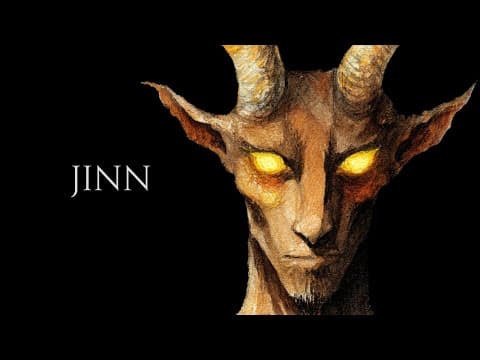
Jinn are beings created from smokeless fire, existing alongside humans but invisible to us. Rooted in pre-Islamic Arabian beliefs and integrated into Islamic cosmology, jinn possess free will and can be good, neutral, or hostile. Their presence explains unexplainable phenomena and reflects a cultural logic born from survival in harsh environments. This article explores their nature, societal parallels, and enduring impact on human understanding of the unseen world.
They live where we don't look, in the places we leave empty, in the moments we say, "Did you hear that?" The jinn are the others who walked the world before us and never left. What if we're not alone? Here, right now, watched.
The concept of jinn is deeply rooted in myths, legends, and folklore worldwide, yet remains underrated in popular discourse. This article delves into the philosophy of jinn, exploring their nature, cultural origins, and the unique role they play in human understanding of the unseen.
The jinn are a class of beings created before humanity, existing alongside us but operating beyond the visible realm. Unlike demons, which are often seen as fallen or corrupted entities, jinn in Islamic tradition are a separate category of creation, made from smokeless fire.
They are our neighbors in the unseen world. According to the Quran, jinn were created before humans and, like us, are capable of faith, denial, obedience, rebellion, love, violence, and thought. They marry, form communities, choose their paths, worship, and deceive.
In many ways, jinn mirror human society but remain hidden, their bodies imperceptible and their movements undetected. What distinguishes them is their access: they see us, but we do not see them. This asymmetry creates a unique kind of fear — the fear of what stands beside us unseen.
Philosophically, the difference between demons and jinn can be seen as the difference between internal struggle and environmental uncertainty. Demons tempt from within, while jinn watch, listen, and wait from without.
Their influence is not framed as possession in the classical sense but as presence — influence without contact, awareness without evidence. You are accompanied, even if unaware.
Unlike demons, which are often defined by a binary of evil or fallenness, jinn can be good, neutral, or hostile. Some believe, some disbelieve, some ignore humans entirely, while others interact. This complexity resists simple classification.
Belief in jinn provides a framework for naming moments when the world feels occupied by something else — a door that opens mysteriously, a cold wind, a misheard voice, or the feeling that something in the room has changed. These are signals that ask, "Who else is here?"
Long before the Quran named them, jinn were already part of the cultural landscape of pre-Islamic Arabia. Belief in unseen beings was a response to lived experience — the heat, distance, silence, and dangers of the open desert.
Jinn were known through encounter and were thought to dwell in abandoned places such as deserts, caves, wells, ruins, and crossroads — spaces where visibility fails and certainty fades. Poets, travelers, and nomads spoke of them with caution. A lone voice in the night could be mistaken for a companion or something else entirely.
Illness without explanation, luck without cause, or misfortune without pattern were often attributed to the influence of unseen spirits. In tribal poetry, jinn appeared both as threats and sources of inspiration. Poets sometimes claimed their verses were given by a companion spirit, while others blamed madness or possession on contact with jinn.
These beliefs were embodied in the worldview of a people whose survival depended on reading signs from an unpredictable landscape. What emerged was a cultural logic:
This was a form of negotiation — a practical response to a world believed to be shared with forces both aware and responsive.
Similar beliefs in unseen beings exist across cultures worldwide. What distinguishes the Arabian tradition is its focus on the emptiness of the land — vast open spaces where presence could be sensed but not verified.
In such environments, belief in jinn was survival logic, a way to explain the unexplainable without assuming chaos.
By the time Islam emerged, jinn were already part of the culture. The Quran absorbed them, clarified their nature, renamed their role, and folded them into a larger cosmic order.
Islamic cosmology introduces a unique view of the universe built on three kinds of beings:
These materials define the nature of each being and the roles they play in the world.
Angels, made of light, do not disobey. They are not designed to choose but to carry out commands flawlessly and endlessly. Their perfection comes from obedience, which is automatic. Light symbolizes the absence of rebellion — it sees but does not stray.
Humans and jinn, however, were created with the capacity to choose — to follow or turn away, to believe or reject. This freedom comes with consequences and accountability.
The fear of jinn, the caution, and the sense of sharing space with something unseen began in the deserts of Arabia and continue today. Their presence challenges human understanding of reality, blurring the lines between the visible and invisible.
Jinn remain a profound symbol of the unknown, a reminder that the world may be more complex and inhabited than it appears. Their philosophy invites reflection on the nature of existence, belief, and the unseen forces that may accompany us.
The philosophy of jinn encompasses a rich tapestry of cultural, religious, and psychological insights. From their origins in pre-Islamic Arabia to their integration into Islamic cosmology, jinn represent a unique category of beings that coexist with humans yet remain hidden.
Their existence challenges us to consider the unseen dimensions of our world and the ways in which belief shapes our experience of reality. Whether viewed as metaphors for internal struggles or as real entities, jinn continue to captivate the human imagination and influence cultural narratives across time and space.