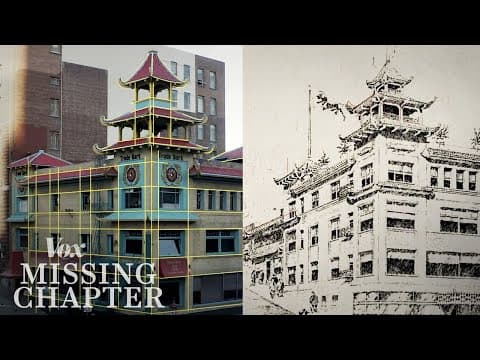
Chinatown's aesthetic, characterized by its iconic gates and pagoda-style roofs, is a product of historical necessity rather than authentic representation of Chinese culture. This blog post explores how Chinese immigrants in the U.S. adapted their architecture to survive discrimination and violence, ultimately creating a unique blend of Chinese and American culture that persists today.
Chinatown is a vibrant and colorful part of many cities around the world, from London to San Francisco. Its entrance often features an elaborate gate, colorful detailing, and a pagoda-style roof. These elements contribute to the iconic look of Chinatowns globally, but they do not reflect the true architectural heritage of China. Instead, they represent a strategic adaptation by Chinese immigrants to protect their community and culture in the face of adversity.
The story of Chinatown's aesthetic begins in the mid-1800s with a wave of Chinese immigrants arriving in the United States, particularly through the port of San Francisco. Many sought economic opportunities in industries such as gold mining, the transcontinental railroad, and factories. However, they faced exploitation and discrimination, especially during the economic depression of the 1870s, when they were scapegoated for taking jobs from white Americans.
This period saw the rise of anti-Chinese sentiment, often depicted as a "yellow peril" in racist cartoons and political rhetoric. The culmination of this hostility was the Chinese Exclusion Act of 1882, which banned Chinese laborers from immigrating to the U.S. and stripped existing Chinese immigrants of their rights, labeling them as permanent aliens.
The anti-Asian sentiment led to widespread violence against Chinese Americans. Historical records reveal a grim picture of this era, including mass lynchings and massacres targeting Chinese communities. In California alone, there were over 200 documented incidents of violence against Chinese individuals and settlements.
As many fled this violence, they sought refuge in San Francisco, which had the largest Chinese American population at the time. However, even within the city, they faced constant threats and restrictions on property rentals, leading to the establishment of Chinatown as a safe haven.
Initially, San Francisco's Chinatown did not resemble the colorful, exotic neighborhoods we see today. It was characterized by standard Western architecture, with Chinese cultural expressions limited to decorations. However, as urban planners eyed Chinatown as prime real estate, they sought to displace the community to make way for Caucasian merchants, believing they could significantly increase property values.
In the early 1900s, exaggerated reports painted Chinatown as a filthy and dangerous area, further justifying the push for its relocation. However, the 1906 San Francisco earthquake changed everything. The disaster devastated the city, destroying much of Chinatown, which was primarily made up of wooden structures.
In the aftermath of the earthquake, city officials saw the destruction of Chinatown not as a tragedy but as an opportunity to execute their plans for relocation. However, the Chinese community had leverage; their businesses were vital to the city's economy, contributing significantly to tax revenues through import duties.
Recognizing this, Chinese American merchants, led by businessman Look Tin Eli, organized to keep Chinatown in its original location. They proposed transforming it into a tourist attraction, shedding its negative reputation.
In the months following the earthquake, the city backed off its relocation plans. Chinese businessmen hired white architects to redesign Chinatown, creating an exoticized version of Chinese architecture. These architects, unfamiliar with authentic Chinese design, constructed buildings with curved eaves, detailed facades, and colorful tiled roofs, often incorporating pagodas that had no religious significance in this context.
This new aesthetic was not meant to accurately represent Chinese culture but to attract tourists and redefine Chinatown as a vibrant part of the city. The transformation set a template for Chinatowns across North America, establishing a unique blend of Chinese and American culture.
Today, Chinatown stands as a testament to the resilience and adaptability of the Chinese American community. It embodies a history of survival amid discrimination and violence, showcasing a culture that has evolved through necessity. However, the challenges faced by the community have not disappeared. Recent years have seen a resurgence of anti-Asian sentiment, exacerbated by the COVID-19 pandemic, reminding us that the struggles of the past continue to resonate today.
Chinatown represents more than just a tourist destination; it is a symbol of a community that has fought to carve out its place in society. Beneath its exotic facade lies a strategic response to historical challenges, preserving a culture that is both Chinese and American. The story of Chinatown is one of survival, adaptation, and the ongoing quest for acceptance in a complex world.